Backlinks still matter in 2026, whether you are trying to rank in traditional Google results or earn visibility in AI-driven answers (like Google AI Overviews, AI Mode, ChatGPT, Gemini, and Perplexity).
The difference is how you plan and measure them: instead of chasing a generic link count, you benchmark the pages and brands already being surfaced, then close the referring-domain gap with a small set of relevant, editorial links.
A professional link building service helps you identify those gaps, prioritize high-value opportunities, and earn relevant editorial backlinks that strengthen your authority over time.
This guide shows you a practical way to estimate how many backlinks you need, with a modern lens that includes both classic SERPs and AI results. You will learn what to benchmark, what numbers are realistic in different competition levels, and how to avoid the link mistakes that get ignored (or worse, discounted) in 2026.
💡 Key Takeaways
- Backlinks still matter in 2026 for both traditional rankings and AI visibility.
- Use referring domains as your primary planning metric, not raw backlink totals.
- Benchmark positions 3 through 10, then close the gap with relevant, editorial links.
- Structure content for extraction (clear definitions, steps, and examples) so AI systems can cite you once you are eligible.
Why there is no universal “right number” of backlinks
There is no fixed backlink count that guarantees rankings because Google still ranks pages comparatively, not absolutely. You are not trying to hit a magic number, you are trying to outperform the pages that already rank for your target query.
That is just as true in AI search. AI systems typically retrieve and summarize from sources they trust, and those trust signals are strongly correlated with classic authority signals. In practice, the pages and brands that dominate competitive traditional SERPs are often the same ones that get cited or used as sources in AI answers.
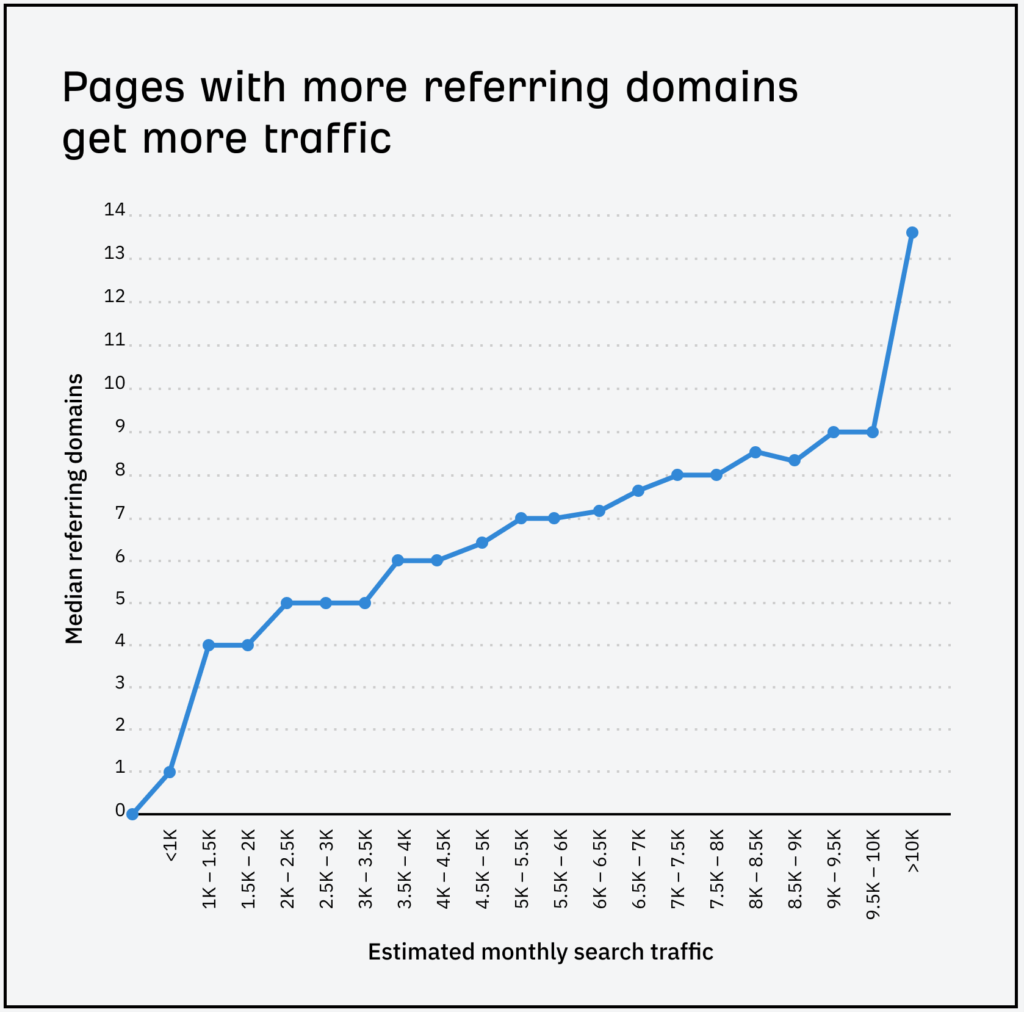
Ahrefs study has consistently found that pages ranking #1 typically have more referring domains than lower-ranking pages, highlighting that rankings depend on outperforming competing pages rather than reaching a fixed backlink threshold.
That said, backlinks are not the only factor. Intent match, on-page clarity, internal linking, and technical accessibility still decide whether your page is even eligible to compete. But links are what typically decide who wins once the content is “good enough.”
Traditional SERPs vs AI results: what changed, and what did not
The big change is that you are now optimizing for two outcomes:
- Traditional rankings (top 3, top 10, featured snippets, “People also ask”).
- AI visibility (being cited, referenced, or used as a primary source in AI-generated answers).
What did not change is the underlying reality: when two pages are similarly relevant, authority still breaks ties. And backlinks remain the most reliable external signal of authority and trust, influencing both traditional ranking systems and which sources AI consider credible enough to cite.
One important nuance for 2026: AI answers tend to reward clear, quotable sections (definitions, step-by-step breakdowns, ranges, and “when to do X” guidance). That does not replace backlinks, it makes your content easier to extract and cite once you have the authority to be retrieved.
Backlinks vs referring domains: the number that usually matters more
Referring domains measure how many unique websites link to you. For planning link targets, referring domains are usually a better proxy for trust than raw backlink count.
That’s because search engines value independent endorsements from multiple relevant websites more than repeated links from the same source. Ten links from ten relevant sites generally send a stronger signal than fifty links from one site. Multiple links from the same site can still help, but diminishing returns are common.
It’s also important not to judge a link solely by whether it’s dofollow or nofollow. Nofollow links can drive referral traffic, diversify your link profile, and lead to future editorial mentions. In 2026, it is more useful to think in terms of visibility and validation than “dofollow only.” That said, followed editorial links remain the most direct way to build ranking power.
What a backlink actually does
A backlink is a third-party signal that your page is worth citing. It can:
- Pass authority (ranking power) to help you compete.
- Reinforce topical relevance when the linking page is in your niche.
- Increase trust by showing independent validation from credible websites.
- Create discovery through referral traffic, brand exposure, and secondary links.
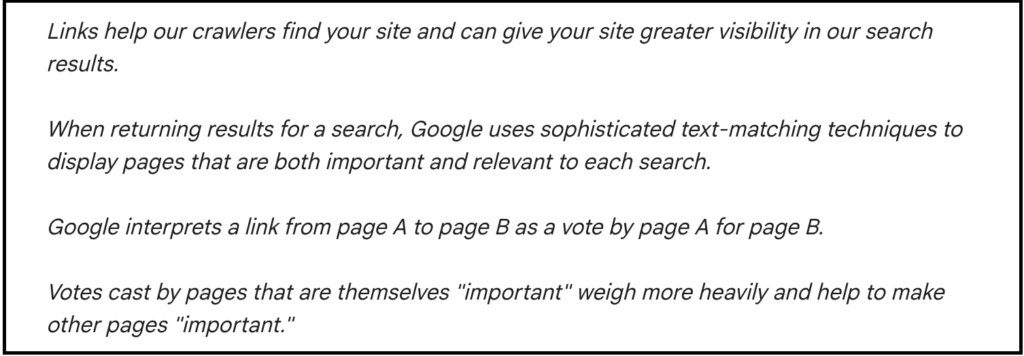
Google has explained this concept for years by comparing backlinks to votes of confidence.
These benefits of link building extend beyond traditional Google rankings. In AI search, that independent validation matters even more because AI systems are cautious about sourcing. A page that is referenced by multiple credible websites is generally more likely to be treated as reliable.
Define the ranking goal before you count links
So, how many backlinks do you need? The answer depends on what you’re trying to achieve. You cannot estimate link needs until you define what “rank” means for this page. It could be:
- Top 3 traditional organic positions for a head term.
- Top 10 visibility for a cluster of long-tail queries.
- Featured snippet or other classic SERP features.
- AI visibility (citations, mentions, or being used as a source in AI answers).
For example, ranking in the top three for a competitive keyword usually requires a stronger link profile than earning visibility for a niche long-tail query.
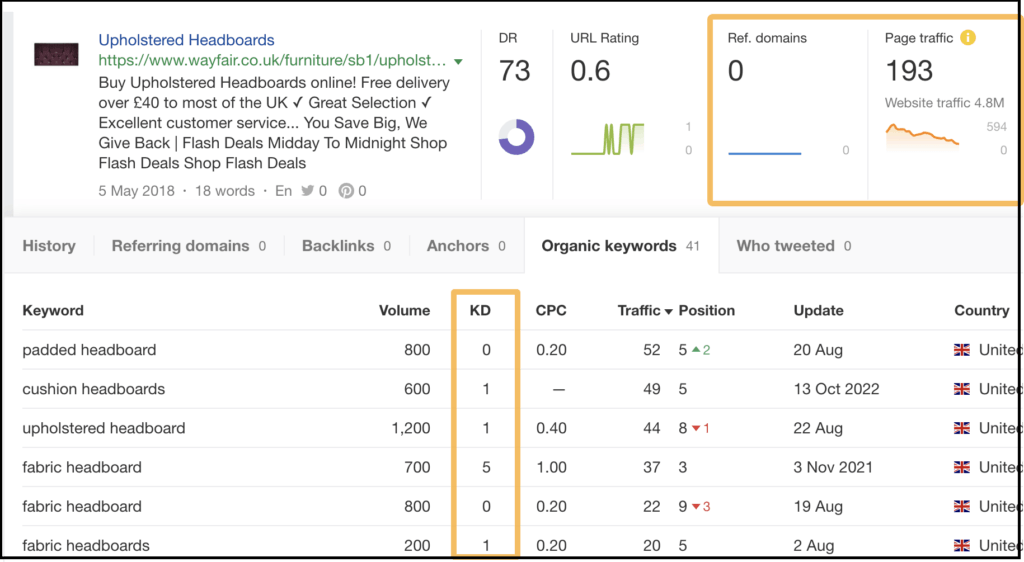
Ahrefs also found that many pages rank without backlinks, though this is largely limited to low-competition topics where authority isn’t the primary differentiator.
Likewise, appearing in AI-generated answers depends not only on authority but also on content that is clear, well-structured, and directly answers the user’s question.
Timing matters too. Links rarely move rankings instantly. You generally need time for crawling, indexing, and reassessment. Plan in months, not days.
Choose the page type you are trying to rank
Different page types attract links differently, and that changes what a realistic backlink target looks like.
- Informational guides earn links more naturally and can rank with fewer links if they provide the best answer to a search query.
- Commercial pages (such as service pages, category pages, “best X” pages) often need stronger internal linking and a strategic link building campaign support because fewer sites link to them organically.
- Tools, calculators, templates, and original research can earn links at a much higher rate, making them effective “link magnets” for supporting your money pages.
In 2026, AI search systems also tend to favor content that is structured, scannable, and backed by evidence. That’s one reason original research, proprietary data, and concrete examples often outperform generic content.
Separate “need to rank” from “need to stay ranked”
Some SERPs are stable. Others are active battlegrounds where competitors publish, refresh, and earn mentions constantly. If you are entering an active category, your “backlinks needed” number is not a one-time target. If competitors continue building high-quality links month after month, maintaining your rankings requires ongoing authority building rather than a single link-building campaign. Think of it as a maintenance threshold, not a finish line.
Here’s how to do it right.
Step 1: Measure competition the practical way (including AI)
Start with the SERP itself. Before worrying about backlink numbers, look at the pages already winning and ask:
- Are major brands dominating the results?
- Are the ranking pages fresh and frequently updated?
- Does the SERP reward a specific format (comparison, tool, guide, definition)?
- Do the winners have visible proof (data, screenshots, case studies, expert authorship)?
For example, a keyword like “CRM software” is dominated by established brands with years of authority and hundreds of referring domains.
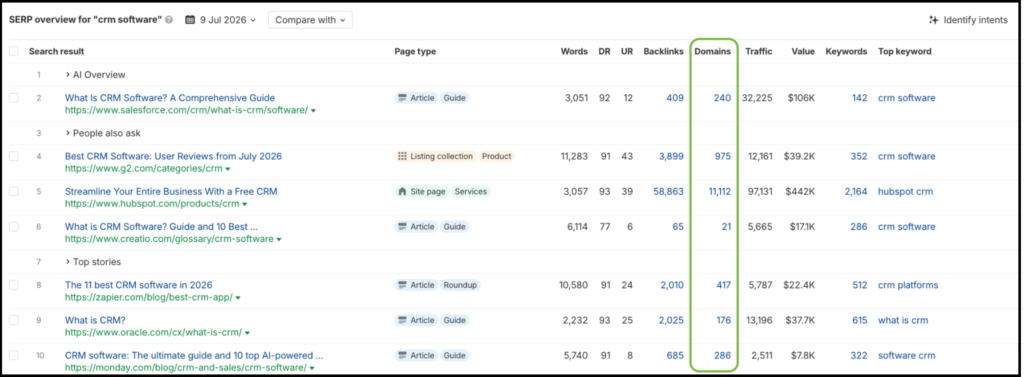
In contrast, a niche long-tail query like “best CRM software for real estate” may have far weaker competition, even if it attracts meaningful search traffic.
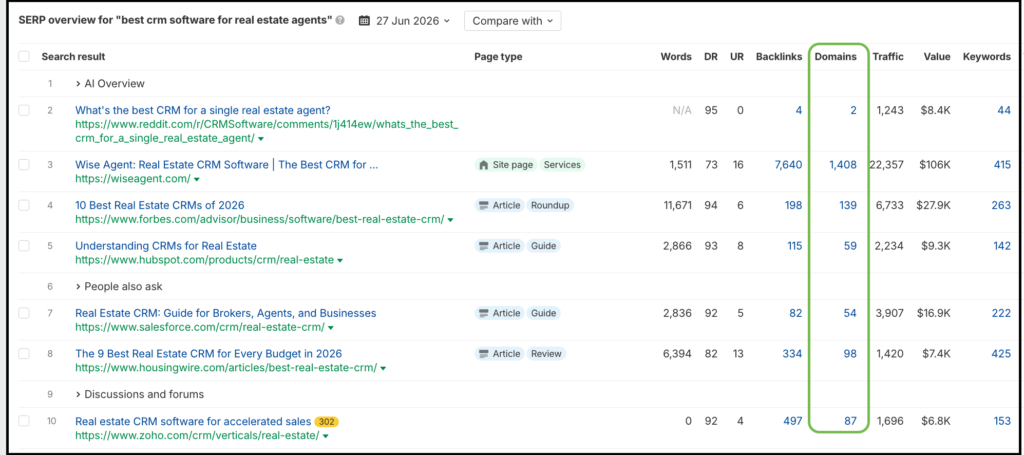
Then add an AI layer: search your target query in AI experiences and note which sources get cited or repeatedly referenced. If the same few domains show up across AI answers, that is a strong signal that authority and brand trust are deciding the “source set.”
A Quick SERP Check That Predicts Higher Backlink Needs
You will usually need more backlinks when:
Tip: When competition is lower than it looks
Some keywords appear highly competitive in SEO tools but are more accessible because the ranking pages don’t fully satisfy search intent.
For example, if the top-ranking articles are outdated, lack supporting evidence, or only partially answer the user’s question, Google and AI systems may simply be waiting for a better resource. In these situations, publishing a more comprehensive, well-structured page can reduce the number of backlinks you need to compete.
Step 2: Benchmark the top results (stop guessing)
A backlink estimate is only useful when it is tied to the pages already ranking. Pull the top 3 to 10 results into Ahrefs, Semrush, or a similar backlink monitoring tool and compare page-level metrics.
A website may have a domain rating (DR) of 80, but the specific page you’re competing against might only have a handful of referring domains. That’s why page-level comparisons provide a far more accurate backlink benchmark.
What to record for each competing URL
- Referring domains to the exact page (most important)
- Total backlinks (secondary, but still useful)
- Anchor text patterns (look for diversity vs manipulation)
- Link quality signals, including editorial placement, topical relevance, and indexation
A simple backlink target formula
Use this baseline formula:
Target referring domains = Median referring domains of positions #3 – 10 (to the exact URL) – Your current page-level referring domains.
For example,
| Ranking Page | Referring Domains |
| Position #3 | 48 |
| Position #4 | 44 |
| Position #5 | 39 |
| Position #6 | 31 |
| Position #7 | 28 |
Median: 39 referring domains
If your page currently has 16 referring domains, your initial gap is 23 referring domains.
This isn’t a guaranteed ranking formula, but it provides a far more realistic target than chasing an arbitrary backlink number.
Then adjust based on page quality:
- If your content is clearly more comprehensive and better aligned with search intent, you may not need to close the entire gap.
- If your page is weaker or doesn’t fully satisfy the query, improve the content first. Building more links to an underperforming page is often an expensive band-aid.
Step 3: Prioritize link quality over link count (even more important in 2026)
Counting links without judging quality creates false confidence. The links most likely to move rankings today are relevant, editorially placed, indexed, and surrounded by meaningful context.
AI visibility follows the same logic. If you want to be cited as a source, you need to look like a source. Links from real publications, niche sites, and expert communities do more than inflate SEO metrics, they create a credible footprint that both search engines and AI systems can trust.
What makes a “good” backlink in 2026
- Topical relevance between the linking page and your page.
- Editorial placement inside the main content.
- Indexation (the linking page is actually in Google’s index).
- Real audience signals (the site and page appear legitimate and maintained).
Red flags that inflate your link count without improving rankings
Avoid backlinks that come from:
- Low-quality directories and irrelevant placements.
- Spun guest posts with weak editorial standards.
- Over-optimized anchors repeated across many links.
- Links that never get indexed or that sit on pages built only for linking.
We’ve put together a detailed guide on toxic backlinks to help you identify and avoid harmful links before they affect your search rankings.
How many backlinks might you need? (ranges, not promises)
These ranges are starting points, not guarantees. The most reliable method is still competitor benchmarking. When you see the ranges below, interpret them as referring domains pointing to the target page, not total backlink counts.
| Competition Level | Typical Referring Domains* |
| Low competition | 0–10 |
| Moderate competition | 10–50 |
| Competitive commercial | 50–150 |
| Highly competitive | 150+ |
These are planning benchmarks only. Your actual target should always be based on competitor analysis.
Low-competition keywords
Typical range: 0 to 10 relevant referring domains.
This is common for long-tail informational queries, niche B2B topics, and some local or emerging categories. If the top results are thin or outdated, strong on-page SEO execution and internal plus local link building can do much of the heavy lifting.
Moderate-competition keywords
Typical range: 10 to 50 referring domains for many long-tail commercial queries, and 50 to 150 referring domains for more valuable head terms.
These campaigns usually work best over several months. Steady acquisition looks more natural and gives Google time to recrawl and reassess. Supporting content can also attract links indirectly, then pass authority internally to the main page.
High-competition keywords
Typical range: 150+ referring domains, and sometimes far more for the most competitive industries and head terms.
At this level, standout assets become mandatory. Original research, tools, and expert-led resources are often what justify the link velocity needed to compete. The goal is not “more links,” it is “more reasons for credible sites to cite you.”
Examples: estimating backlinks with realistic scenarios
The same backlink count can produce very different outcomes depending on who links, where they link, and what page they support. That is why backlink gap analysis works better than copying someone else’s number.
Scenario A: New page on an established domain
Imagine a new guide published on a domain with strong topical coverage and internal linking. If the pages ranking in positions 3 through 10 have a median of 18 referring domains to the URL, and your page has 4, your initial gap is 14.
If your page is clearly the best answer and is structured for extraction (tight definitions, clear steps, and strong examples), you may not need to close the entire gap to start showing up in both traditional results and AI citations. A smaller number of highly relevant editorial links can be enough to move into contention over a few months.
Scenario B: New domain competing against strong brands
Now imagine a new domain targeting a competitive commercial keyword where the ranking pages have a median of 35 referring domains and belong to recognized brands. The page-level gap might be 35, but the real challenge is that the domain lacks accumulated trust.
In that case, you usually need both page-level links and broader authority growth across the site. A smarter path is to start with long-tail terms, build topical coverage, earn mentions, and compound authority before chasing the head term.
Common mistakes that waste backlink budget (and hurt AI visibility)
The most expensive mistake is chasing a backlink number instead of closing the real gap in the SERP. If the wrong page is being promoted, or the content does not match intent, more links simply make the wrong asset stronger.
For example, if a service page lacks clear information, supporting evidence, or a compelling user experience, earning additional backlinks is unlikely to outperform competitors with stronger content.
Other common failures include:
- Building links to URLs that later change without proper redirects
- Ignoring internal linking
- Letting technical issues, such as noindex tags, crawlability problems, and slow load time, suppress the impact of good links
How to track progress without getting lost in metrics
It’s easy to get distracted by daily ranking fluctuations, but meaningful SEO progress is measured over weeks and months.
Tracking the right link building metrics helps you understand whether your strategy is delivering meaningful results. Rankings only matter if they produce qualified traffic and conversions.
A few SEO signals that explain movement:
Page-level referring domains to the target URL.
Search Console impressions and clicks for the query set.
AI visibility indicators (whether your page is being cited or referenced in AI answers for the target topic).
A monthly review cadence is usually enough to see real trends. Daily rank watching creates noise because crawling and SERP testing can cause short-term fluctuations.
Example: How Page-Level Referring Domains Translate Into Rankings
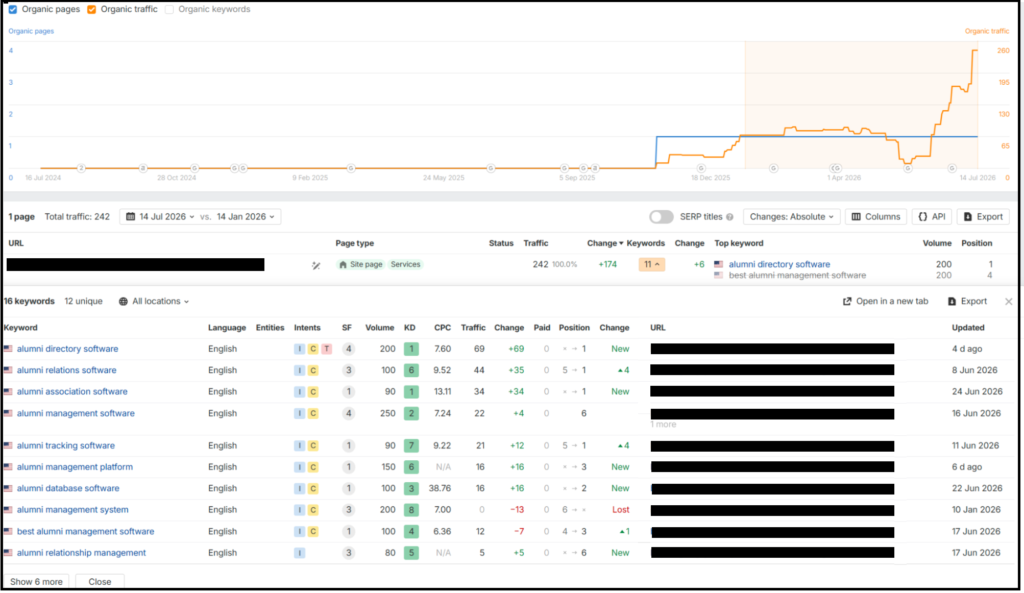
At Tanot Solutions, a B2B client wanted to improve the visibility of a commercial page targeting the keyword “alumni management platform.” Over six months, we built 15 high-quality editorial backlinks from relevant referring domains as part of a broader authority-building strategy.
Rather than focusing only on the number of backlinks acquired, we tracked the business outcomes. The page reached Position #1 for its primary target keyword, ranked for several additional relevant search terms, and increased its page-level organic traffic by approximately 280%.
A monthly review cadence is usually enough to see real trends. Daily rank watching creates noise because crawling and SERP testing can cause short-term fluctuations.
Conclusion: How Tanot Solutions thinks about “enough links” in the AI era
The practical way to estimate link needs is simple: benchmark the pages currently winning, measure the referring-domain gap, and close it with relevant, editorial links. That turns a vague SEO question into an operational plan grounded in reality.
Tanot Solutions sets link targets by benchmarking the SERP first, then building the smallest set of high-trust links needed to close the gap. The same approach applies to AI visibility, because the pages that get retrieved and cited tend to be the ones with the strongest blend of relevance and authority.
The work stays measurable through a transparent process with client approvals before link placements go live. In 2026, that control matters because verified, relevant placements are what move both rankings and trust.
If you’re looking to build sustainable organic growth rather than simply increase backlink counts, contact us today.