
You’re a startup investing in good content, and you’ve built a product people actually want. So why isn’t your website bringing in more organic traffic, or showing up when potential customers ask AI for recommendations?
You may be missing one important piece: off-site authority.
Recent research found that top-three Google results have nearly 5x more backlinks than positions 4–10, while sites with stronger backlink profiles also tended to earn more citations across Google AI, ChatGPT, and Perplexity.
But if you’re working with a startup budget, where do you start?
This guide shows you how to build quality backlinks and off-site authority without wasting money on links that don’t move your SEO forward.
💡 Key Takeaways
- Link building for startups can help close the authority gap, improve search visibility, and build credibility beyond your own website.
- Prioritize backlinks based on relevance, authority, and real value rather than metrics such as DR alone.
- Start your link building budget around $500/month, move toward $1,500 as you identify what works, and invest more as your authority grows.
- Avoid bulk link packages, PBNs, irrelevant placements, and other shortcuts that can waste your budget and create unnecessary risk.
- Consider link building specialist support when consistent prospecting, outreach, and link vetting become difficult to manage in-house.
Why Link Building Matters for Startups
Both traditional search engines and AI search systems look at signals from across the web to understand a website and determine how much visibility it deserves. Backlinks are one of those signals.
For startups, link building can help you:
- Close the authority gap: Your competitors may have spent years earning links from industry publications, partners, media outlets, and other established websites.
- Improve search visibility: Relevant backlinks can support your ability to rank in traditional search and also contribute to how your brand is surfaced and cited in AI search.
- Build credibility outside your own website: When other relevant websites reference your company, you’re not relying solely on your own site to establish your expertise.
But there’s an important caveat: closing the authority gap doesn’t mean chasing the biggest number of links.
The Small Business SEO Impact Report 2025 found that businesses prioritizing industry-relevant backlinks saw 2.1x better ranking improvements than those prioritizing high-DA links without topical alignment.
A Step-by-Step Link Building Strategy for Startups
You don’t need to launch a full-scale outreach campaign on day one. Start with the opportunities closest to you, learn what works, and build from there.
1. Start with competitor backlink analysis
Before looking for link opportunities, find out who is already linking to the startups you’re competing with.
Tools such as Ahrefs or Semrush let you enter a competitor’s domain and view its referring domains and backlinks. Start by looking at several competitors, rather than relying on just one.
For instance, Ahrefs’ Link Intersect lets you compare the backlink profiles of multiple competitors and find websites that link to them but not to you.
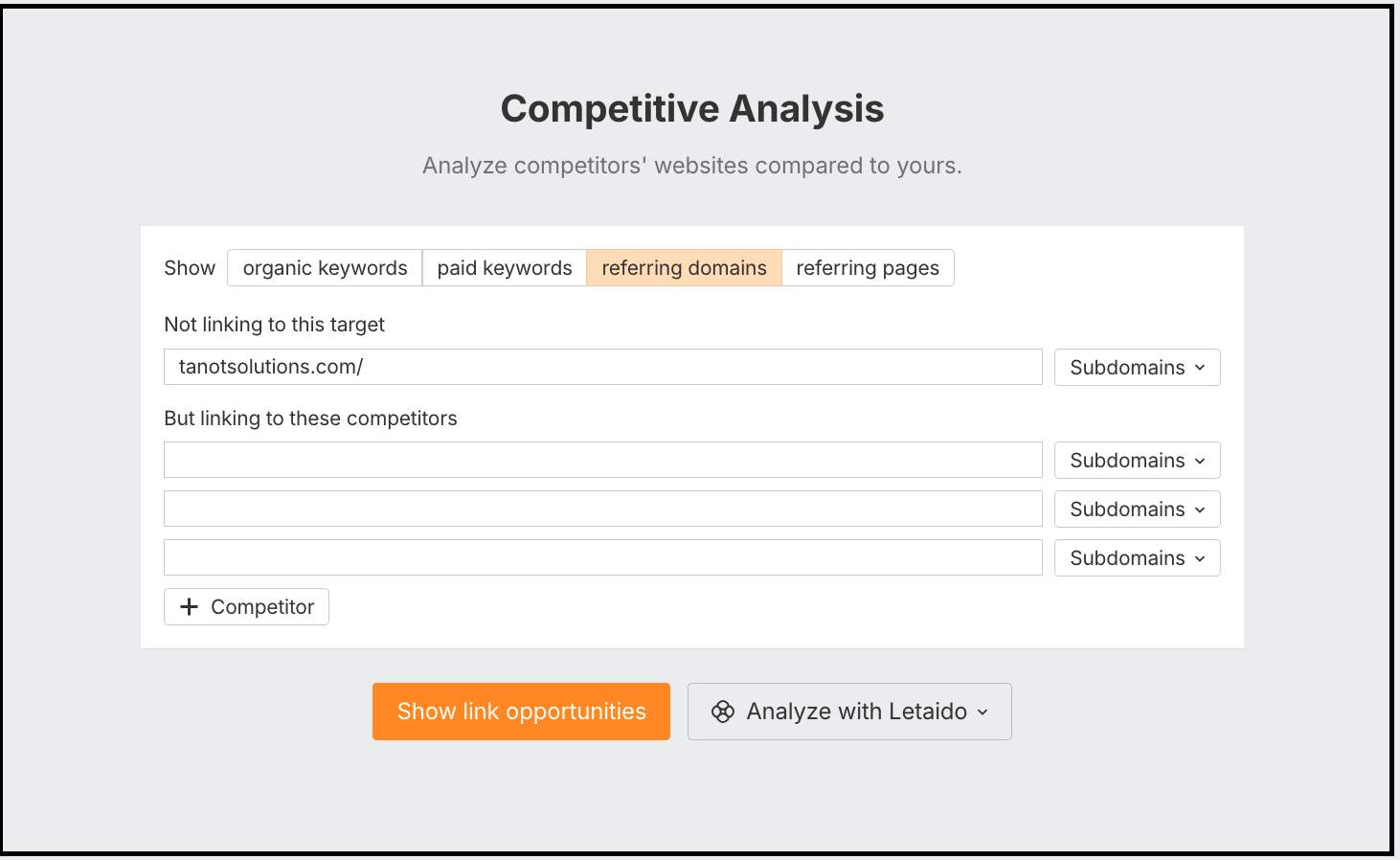
Once you have the report, filter your prospects based on:
- Links to multiple competitors. If a website links to two or more of your competitors, it’s more likely to be relevant to your industry and worth investigating.
- Relevant industry or topic. Prioritize websites whose content and audience align with your startup, rather than chasing high-DR domains with no topical connection.
- Quality and potential value. Look for established websites with genuine content and traffic where a link could actually put your brand in front of the right audience.
This backlink gap analysis will give you a much more relevant prospect list to prioritize for outreach instead of starting from hundreds of random websites.
2. Reclaim unlinked brand mentions
Someone may already be talking about your startup without linking to your website. These are often some of the easiest opportunities to pursue because the website has already decided your brand is worth mentioning.
You can use tools such as Google Search, Ahrefs Content Explorer, or Semrush’s Brand Monitoring to find these mentions.
For example, in Google, try searches such as:
“Your Brand Name” -yourdomain.com
or:
“Your Product Name” -yourdomain.com
If it’s a relevant mention without a link, reach out to the publisher or author with a simple outreach message to link to the relevant page.
Brand mention link reclamation can produce results within a few weeks when the opportunity is straightforward. However, sometimes it can take longer depending on the publisher, the relevance of the mention, and whether they need to make editorial changes.
3. Turn partnerships into backlinks
Your existing network can be one of your most valuable sources of early links.
Relevant opportunities may come from your customers, technology and integration partners, investors, accelerators, agencies, and other companies you work with, and look for natural ways to get your startup mentioned.
For example, an integration partner may have a partner directory or integration page where your company belongs. A startup accelerator may feature its portfolio companies on its website.
And if you’re part of an industry community, association, founder network, or professional group, check whether they feature members or maintain a member directory.
Once you find a relevant opportunity, keep your link building email outreach simple. Give them a specific reason to include you.
| Subject: Quick request for [Company] Hi [Name], We noticed that [specific page] features [partners/customers/tools] and thought [Your Company] could be a relevant addition, given our [partnership/integration/customer relationship]. Would you be open to including us here? Happy to send over a short description and the relevant URL to make it easy. Thanks, [Name] |
4. Create content people have a reason to cite
A tried-and-tested link building strategy for startups is to create content that other publishers have a reason to reference.
For instance, HubSpot’s “AEO Checker Tools That Measure Answer Engine Visibility” blog garnered around 100 backlinks.
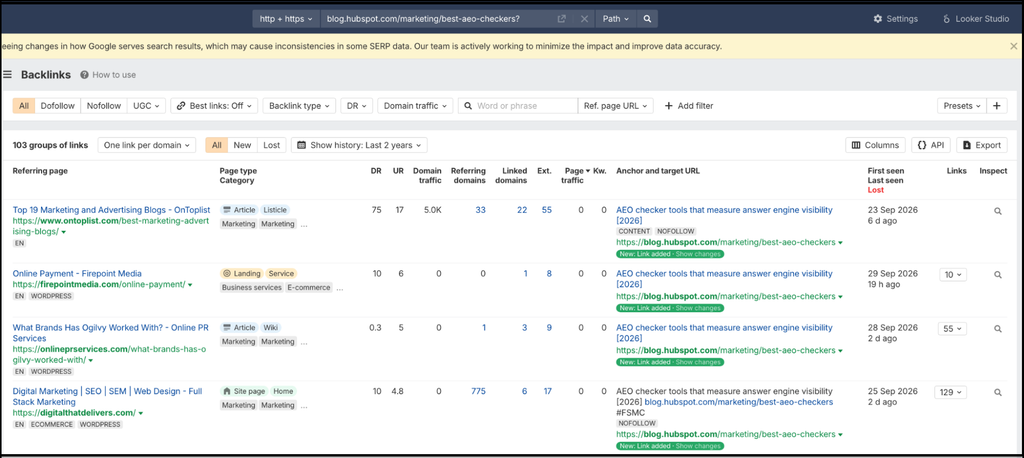
The article shares practical advice on how to measure and evaluate AI visibility, giving other publishers a useful resource to reference when discussing the topic.
For a startup, that could mean publishing original research or industry data, creating a useful tool or resource, or taking a strong point of view on an industry problem.
A founder, for example, could write a thought leadership piece explaining a pain point they’ve repeatedly seen in the industry, or publish an ebook exploring where the industry is heading and what businesses need to change.
The more useful and reference-worthy the asset, the more reasons other websites have to cite it.
And unlike outreach campaigns that stop when you stop pitching, one genuinely useful asset can continue earning links long after you publish it.
5. Use guest posting selectively
Guest posting can help startups get in front of relevant audiences while earning editorial backlinks, but quality matters more than publishing volume.
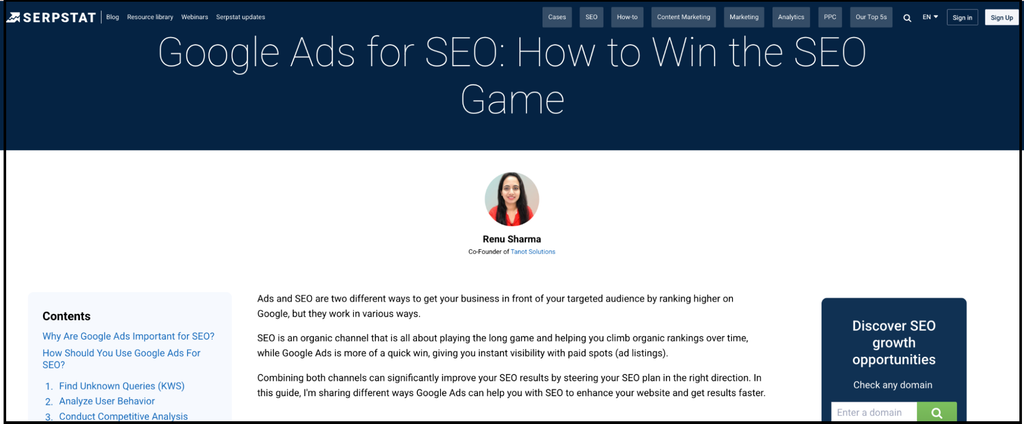
For example, Tanot Solutions contributed “Google Ads for SEO: How to Use PPC Data to Improve Organic Search” to Serpstat, connecting the topic directly to the publication’s SEO audience.
Look for websites that:
- Cover your industry or adjacent topics
- Have a genuine audience
- Publish original, useful content
- Maintain clear editorial standards
Then pitch a topic that makes sense for their readers.
Don’t approach guest posting as a way to place the same article and anchor text across dozens of websites. A smaller number of genuinely relevant contributions can be much more valuable.
6. Find resource pages and relevant listicles
Look for third-party pages that already curate businesses, products, tools, or services in your category.
For example, a SaaS startup can build profiles on relevant software review and business platforms such as G2, Software Advice, or Clutch. An appliance repair business can look for reputable local and industry directories where service providers are listed.
You can also search for relevant:
- Industry resource pages
- “Best [category]” lists
- Startup directories
- Product comparison pages
Vet the site first before submitting your business. Avoid spam directories filled with unrelated websites, automated link-submission networks, and PBNs disguised as “free backlink opportunities.”
7. Use founder expertise to earn links
Your founder can become a link building asset, particularly when the company itself doesn’t have much brand recognition yet.
Respond to expert-commentary opportunities on platforms such as HARO and Featured, as well as relevant journalist requests in your niche. You can also pursue:
- Podcasts
- Industry interviews
- Founder stories
- Expert roundups
- Startup features
For example, Tanot Solutions contributed expert advice to GoDaddy’s article, “Measuring SEO Success Beyond Rankings,” earning the brand a relevant niche mention.
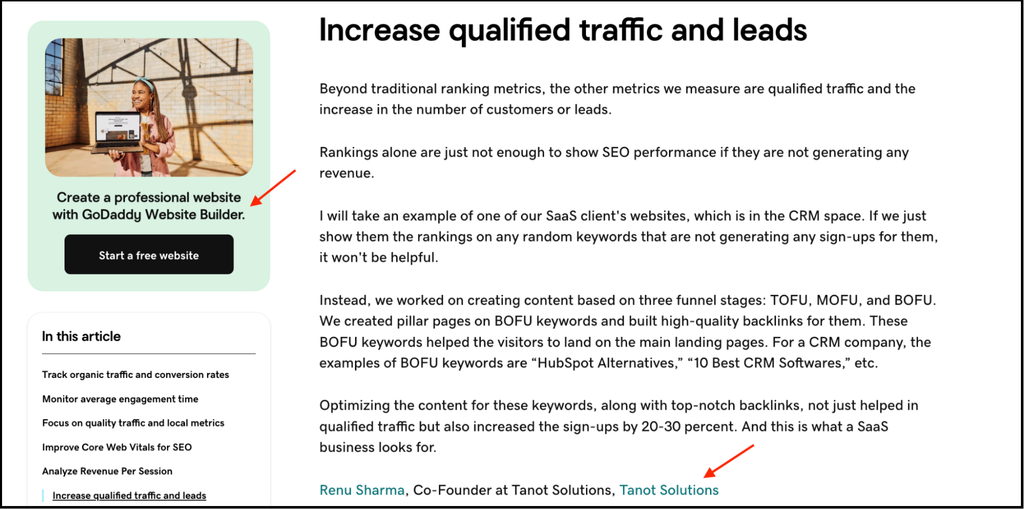
This works because you’re putting your founder in front of an audience that already cares about the problem you solve.
How Much Should a Startup Spend on Link Building?
A practical approach to link building for a startup is to start with a small budget of around $500 per month and increase it gradually as you start seeing traction.
As your results become more consistent, you’ll also have a clearer ROI track record to justify increasing your investment.
Stage 1: Start with around $500/month
If you’re just starting out, a $500 monthly budget is enough to test different link building tactics without committing to a large campaign.
At this stage, focus on lower-cost and earned opportunities, such as reclaiming brand mentions, leveraging partnerships, contributing expert commentary, and pitching relevant guest posts or resource pages.
You can use the budget to hire a link building specialist for prospecting, outreach, and vetting opportunities, rather than paying for a fixed number of links.
The goal is to find out what works for your niche, build your first relevant links, and create a foundation you can scale as your authority grows.
Stage 2: Expand toward $1,500/month
Once you’ve identified what works, increase your budget to pursue more competitive opportunities and consistent outreach.
At around $1,500 per month, you could allocate the budget toward:
- 2–3 editorial placements: Around $ 300-500 each, depending on the publication.
- Prospecting and outreach: Around $ 200-300 for finding and contacting relevant opportunities.
- Content and expert-led campaigns: Around $200-300 for guest posting or promoting assets that can earn links.
The exact mix will vary, but the goal is to earn fewer, stronger links rather than chase volume.
Stage 3: Go beyond $1,500/month as authority grows
Once your site has built some authority and you’re competing for harder keywords, you can increase your investment in higher authority editorial placements.
At this stage, many startups work with a link building specialist who can identify suitable publications, handle outreach, and secure relevant placements.
Specialists typically charge per link or offer customized monthly packages based on the publication quality, number of links, and level of outreach involved.
At Tanot Solutions, typical campaigns range from $2000 to $15,000+ per month, depending on the client’s goals and campaign scale. Businesses have achieved up to 5x SEO results through these campaigns.
Link Building Mistakes Startups Should Avoid
A limited budget makes it even more important to avoid tactics that consume resources without creating lasting value.
Be cautious of:
- Bulk backlink packages: Hundreds of links at a suspiciously low price usually come with little control over quality.
- Irrelevant directories: A directory link isn’t valuable simply because it exists.
- Spammy guest-post sites: Publishing anywhere that accepts paid or low-quality contributions can dilute your link profile.
- Excessive exact-match anchor text: Your backlink profile should develop naturally rather than relying on repetitive keyword-heavy anchors.
- Chasing DR alone: A high domain rating doesn’t automatically mean a site is relevant or valuable to your audience.
- Measuring success by link count: Ten relevant links can be more meaningful than 100 low-quality ones.
When Should a Startup Outsource Link Building?
You don’t need to outsource link building from day one. If you have the time to research prospects, build relationships, and handle outreach yourself, start there.
Outsourcing starts to make sense when:
- Outreach is taking time away from core marketing work.
- You know which types of links you want but don’t have the resources to find and vet opportunities at scale.
- You’re entering more competitive search results and need stronger editorial placements.
- You want a consistent link building process rather than occasional outreach.
The right link building service provider should do more than deliver a list of backlinks. They should understand your SEO goals, find relevant opportunities, handle outreach, and let you review placements before they go live.
That’s the approach Tanot Solutions takes: every backlink is selected around your SEO strategy and approved by you before publication.
If you’re ready to build a backlink profile for your startup that supports long-term organic growth, contact us today.