Backlinks take time, effort, and resources to earn, but they don’t always stay intact. Site redesigns, deleted pages, faulty redirects, and content updates can cause valuable backlinks to break or disappear, reducing referral traffic and weakening the authority you’ve already built.
This guide explains how to identify lost backlinks, restore link equity, diagnose why links get lost, and measure the business value of what you recover. You’ll also learn when to use redirects, when to contact publishers, and how link reclamation supports technical SEO, off-page SEO, indexing, and organic growth.
What Is Link Reclamation?
Link reclamation is the process of restoring value from backlinks, brand mentions, image credits, and other external references that were lost, broken, misdirected, or never properly linked. In practical terms, another website may still reference your content, but its external link, destination URL, attribution, or anchor text no longer works as intended.
The goal isn’t to create new demand but to recover authority, referral traffic, and discoverability that your business has already earned. Google explains that pages are discovered through links from known pages or sitemaps before they are crawled and indexed for Search.
Because AI Overviews rely on the same core Search systems rather than a separate AI index, maintaining accessible, indexable, and well-connected pages also supports your visibility across Google’s search experiences.
Google’s documentation also says that AI Overviews include links to supporting references, making it even more important that your valuable pages remain accessible through working backlinks.
Not every repaired link passes the same potential value. Google treats nofollow, sponsored, and UGC link attributes as hints for crawling, indexing, and ranking rather than direct endorsements. While nofollow links shouldn’t be viewed as equivalent to standard dofollow links, they can still drive qualified referral traffic, reinforce brand attribution, and increase visibility among relevant audiences.
Benefits of Recovering Lost Backlinks
Link reclamation protects the value of your existing content, digital PR, and previous link building efforts. It’s particularly valuable for websites that have undergone URL changes, site redesigns, content pruning, or domain migrations, where earned backlinks can easily become broken or outdated.
A working backlink helps search engines discover your pages, passes authority to important content, and directs visitors to relevant resources. When that link breaks, users encounter errors, publishers send traffic to outdated URLs, and search engines lose a direct path to your content.
Recovering lost backlinks helps restore that value while improving both user experience and search visibility.
Key benefits include:
- Recover earned link equity: Restore the value of legitimate editorial backlinks by fixing broken URLs, redirects, and other technical issues.
- Protect organic traffic: Ensure visitors from referring websites reach relevant pages instead of 404 errors.
- Support crawling and indexing: Healthy links help search engines discover and understand important pages.
- Improve technical SEO: Backlink audits often uncover broken pages, redirect chains, canonical issues, and URL migration problems.
- Strengthen commercially important pages: Reclaimed backlinks can reinforce product, solution, category, and comparison pages that contribute to qualified leads and revenue.
- Preserve editorial credibility: Correct source links and image credits help readers verify information while maintaining proper attribution.
Not every recovered backlink delivers the same business value. Prioritize opportunities based on topical relevance, editorial quality, referral potential, and the importance of the destination page.
In many cases, one authoritative editorial link pointing to a commercially important page is more valuable than dozens of low-quality recoveries. Link reclamation should complement, not replace, high-quality content and ongoing link-building efforts.
Link Reclamation Opportunities
Not every backlink loss requires the same solution. Common link reclamation opportunities worth investigating include:
- Lost backlinks pointing to deleted pages or returning 404 errors
- Broken backlinks containing incorrect or outdated URLs
- Unlinked brand mentions where your business is referenced without a hyperlink
- Missing image credits for original charts, infographics, or graphics
- Redirect chains that delay or weaken the path to the intended destination
- Faulty redirects leading users to irrelevant pages
- Editorial links removed during content updates or website refreshes
- Backlinks pointing to old URLs following a site redesign, URL migration, or domain migration
Prioritize opportunities that come from relevant referring domains, credible editorial websites, and pages that support your most important business or conversion goals.
Link Reclamation vs. Link Building
Although link reclamation is closely related to link building, the two strategies serve different purposes.
Link building focuses on earning new editorial backlinks from relevant publishers, while link reclamation restores or corrects backlinks, citations, or brand mentions your website has already earned. Because the publisher has already recognized the brand or content as useful, this kind of recovery can often be more efficient than starting a new outreach campaign from scratch.
Practitioner benchmarks report that this work commonly shows results within 1 to 4 weeks, compared to months often required for new link building campaigns. Actual timeline varies depending on the quality of the opportunity, technical complexity, and whether publisher intervention is required.
| Factor | Link building | Link reclamation |
| Starting point | No existing citation or relationship is required | An existing backlink, mention, image use, or historical reference exists |
| Primary goal | Earn new editorial links | Recover lost backlinks and restore link equity already earned |
| Typical work | Prospecting, content creation, pitching, and relationship building | Backlink audit, technical fixes, verification, and targeted outreach |
| Common technical actions | Improve linkable assets and internal links | Fix 404 errors, redirects, canonical tags, and URL migration issues |
| Best measurement | Relevant new referring domains and business impact | Verified recovered links, resolved broken targets, referral traffic, and priority page performance |
How to Reclaim Lost Backlinks Step By Step
The most effective approach is to identify opportunities, verify the issue, fix what you control, and contact the publisher only when external action is required. Following this sequence avoids unnecessary outreach and ensures you can provide editors with the correct replacement URL when needed.
Step 1: Find lost and broken backlinks
Use Google Search Console to review external links and combine its data with lost link reports from Ahrefs, Semrush, Moz, or Majestic. Since each tool maintains a different backlink index, comparing reports can uncover opportunities that a single platform may miss.

Ahrefs identifies a backlink that has been reported as “Lost: Link removed”
Next, crawl important broken URLs with Screaming Frog SEO Spider and compare the results with historical backlink exports to identify technical issues on your site that are causing valuable backlinks to break.
Step 2: Verify the link and diagnose the cause
In the example above, the backlink has been reported as removed. Open the referring page and verify whether the link has actually been removed, changed to plain text, or redirected to a different URL.
If the backlink is no longer present, as in the example above, it may have been removed during a content update, replaced with another resource, or lost due to changes in the page structure. In these cases, review the surrounding context before deciding whether an editorial outreach request is appropriate.
If the backlink still exists, check the destination URL to verify whether it returns a 200 response, redirects with a 301 or 302, returns a 404, or produces a server error. This helps determine whether the issue is a broken destination, an incorrect redirect, or simply a reporting discrepancy before deciding on the appropriate next step.
Step 3: Fix what you control first
Restore useful deleted content, implement an appropriate 301 redirect, repair internal links, and correct an inaccurate canonical tag before contacting another website. A canonical tag should identify the preferred version of a page, not point search engines to an unrelated or unavailable URL.
Do not redirect every broken address to the homepage. Visitors and search engines need the closest topical replacement, and irrelevant redirects can be interpreted as soft 404s rather than meaningful continuations.
Step 4: Send a clear, helpful outreach request
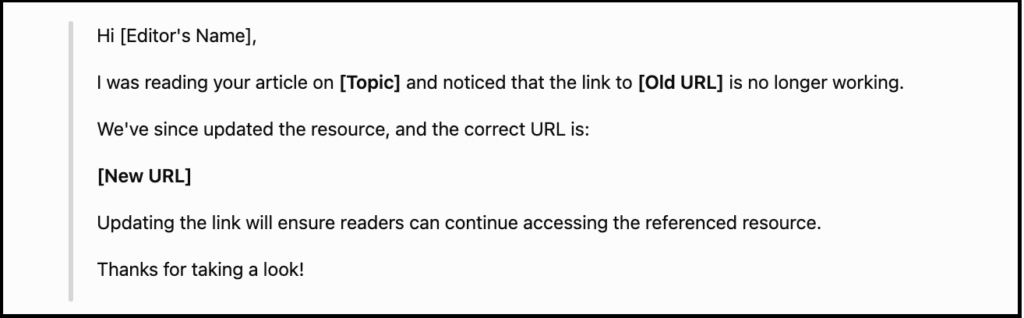
Keep your outreach message short and specific. Identify the publisher’s page, explain the broken or missing reference, provide the correct destination URL, and briefly describe how the update benefits readers. Thank the editor for their time, but avoid pressuring publishers or offering misleading incentives. Editorial links should always remain relevant, accurate, and at the publisher’s discretion.
Here’s a simple outreach template you can customize for your link reclamation requests.
Best tools for recovering lost backlinks
No single backlink monitoring tool discovers every referring domain. Combine backlink monitoring with technical crawling and live-page verification to determine whether a lost link requires a redirect, content restoration, or publisher outreach.
● Google Search Console: Review external links, index coverage signals, and page-level search performance to identify your most important target pages.
● Ahrefs, Semrush, Moz, or Majestic: Monitor lost and new backlinks, referring domains, anchor text, and historical trends. Use their reports to identify opportunities, then verify the live source manually.
● Screaming Frog SEO Spider: Crawl old and current URLs to identify 404 errors, redirect chains, broken internal links, canonical issues, and migration gaps.
● Server logs and analytics: Review whether valuable old URLs still receive requests and whether recovered links produce referral visits.
● A shared tracking sheet or project tool: Track each opportunity, owner, technical action, outreach status, and final outcome.
Examples of Link Reclamation in Action
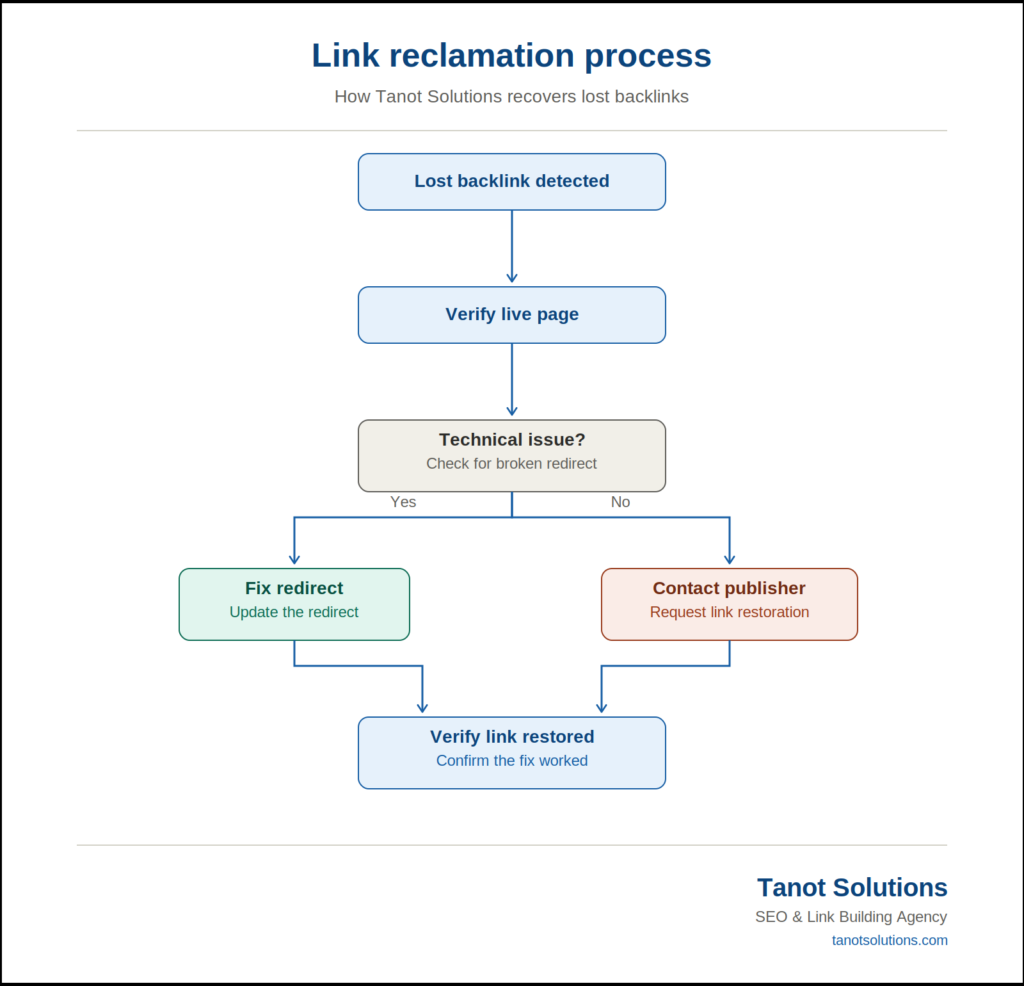
Let’s understand this with the help of an example. A B2B SaaS company earned an editorial backlink to an integration page that was later removed during a website migration, leaving the original URL returning a 404. Because the new site included an equivalent integration page, the SEO team implemented a direct 301 redirect, verified that it didn’t create a redirect chain, and confirmed the destination was relevant and indexable.
In another case, a publisher may remove your backlink during a content refresh or replace it with a different resource. If your content is still relevant and adds value to the article, you can reach out to the editor, explain the change, and request that the link be restored or updated with the correct URL.
These examples illustrate that successful link reclamation starts with identifying the root cause. Some opportunities require a technical fix, while others are resolved through a simple editorial update.
Common Mistakes to Avoid While Reclaiming Lost Backlinks
Avoid these common mistakes when reclaiming lost backlinks:
- Treating every lost backlink as equally valuable: Prioritize opportunities based on the referring domain’s relevance, editorial quality, referral potential, and the importance of the destination page.
- Relying solely on backlink tools: A reported lost link may be caused by crawl timing, temporary downtime, or rendering issues. Always verify the live page before investigating or contacting the publisher.
- Sending generic outreach emails: Clearly identify the broken or missing reference, provide the correct replacement URL, and explain how the update benefits readers.
- Ignoring editorial context: Not every removed backlink should be reclaimed. If a publisher has updated their content and your page is no longer the most relevant source, respect that editorial decision.
- Using redirects as a catch-all solution: Redirect broken URLs to the closest relevant page, not the homepage or an unrelated destination. Avoid long redirect chains, and restore the original content when it remains valuable and there’s no suitable replacement.
How to Measure Success for Link Reclamation
Measure success based on verified outcomes, not activity counts. A recovered link count without verification may include nofollow links, irrelevant pages, or links that still pass through faulty redirects, so always confirm the final implementation.
Track these metrics for priority opportunities:
● Recovered live links and restored referring domains
● Resolved 404 targets and direct redirects replacing redirect chains
● High-priority URLs restored with a relevant, indexable replacement
● Referral visits and engagement from reclaimed editorial links
● Organic traffic, impressions, clicks, and search rankings for priority target pages
● Changes in the number and quality of referring domains to strategic content
● Outreach performance, including emails sent, responses, approved updates, and verified link recoveries
Report technical fixes, publisher outreach, and confirmed recoveries separately. This helps identify which efforts delivered results and which opportunities still require action.
Final Thoughts: Link Reclamation Into Your SEO Routine
Recovering lost backlinks is a repeatable way to restore link equity and protect the value of past content and off-page SEO investment. Start with high-value referring domains and broken destinations, fix the technical issues you control, then use precise outreach only where an editorial update is necessary.
Build link reclamation into your regular SEO routine by monitoring lost backlinks, maintaining clean redirects, and reviewing high-value pages after major website changes. Recovering existing value first creates a stronger foundation for future link-building campaigns and supports more sustainable organic growth.
At Tanot Solutions, we approach link reclamation through a data-driven review of referring domains, technical issues, and backlink quality. The goal isn’t to recover the highest number of links but to restore the backlinks that have the greatest impact on your website’s visibility, authority, and long-term business growth.
Want to identify and recover your highest-value lost backlinks? Contact us for a data-driven backlink audit and link reclamation strategy tailored to your website.