
With AI-powered search changing how people discover information, the role of traditional SEO is being questioned.
Does SEO still matter when users can ask ChatGPT, Google AI Overviews, or other AI tools a question and get a direct answer?
While answer engine optimization (AEO) introduces new considerations for AI visibility, it doesn’t replace the fundamentals of SEO.
At a recent Search Central Deep Dive event, Gary Illyes stressed that “the fundamental principles of SEO are more important than ever for appearing in new AI-powered features.” Kenichi Suzuki, who attended the event, highlighted the point in his LinkedIn summary.
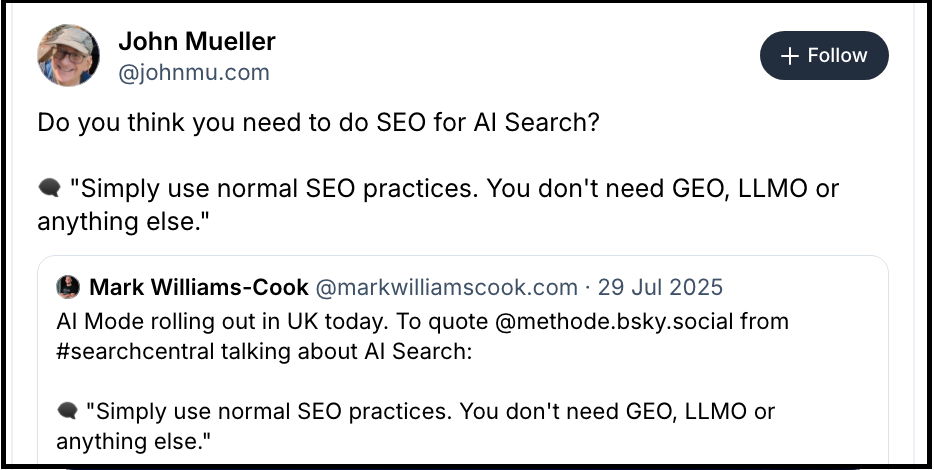
John Mueller, Senior Search Analyst at Google, quoting Gary Illyes
And at the core of those fundamentals is white hat SEO: building the signals that make your website genuinely worthy of visibility.
Here are 13 white hat SEO techniques to improve your Google visibility while strengthening your presence in AI-powered search.
💡 Key Takeaways
- White hat SEO focuses on sustainable visibility by improving how your website performs, serves users, and earns recognition in search.
- SEO fundamentals still matter for AI search, from crawlability and search intent to content quality and E-E-A-T.
- AI visibility extends beyond your website, with relevant backlinks and brand mentions contributing to your broader digital authority.
- Keep optimizing and refreshing your content as search behavior, information, and AI-powered search systems continue to evolve.
What Is White Hat SEO?
White hat SEO refers to optimization practices that follow search engine guidelines while providing genuine value to users. In practice, it means optimizing for people, not trying to trick the algorithm.
That matters even more as AI makes it easier to produce content at scale. Google warns against creating large volumes of unoriginal content primarily to manipulate search rankings, including scaled content generated with AI.
However, white hat SEO isn’t about avoiding AI or following a rigid checklist. It’s about creating something people can genuinely use and trust.
White Hat SEO vs. Black Hat SEO: The Difference
The difference comes down to intent and execution.
| White Hat SEO | Black Hat SEO |
| Improves how well the site serves its audience | Primarily aims to manipulate search rankings |
| Builds authority through useful content and legitimate links | Uses manipulative link schemes or other ranking shortcuts |
| Targets genuine user needs and search intent | Exploits loopholes or violates search engine guidelines |
| Uses keywords naturally and contextually | Relies on keyword stuffing or hidden text |
| Builds sustainable search visibility | Can result in penalties or loss of search visibility |
| Creates long-term value for users and the business | Often produces low-value pages designed mainly to attract search traffic |
13 White Hat SEO Techniques for Google and AI Search Visibility
Sustainable search visibility is built across multiple layers, including technical accessibility, content quality, and external authority.
Here are 13 white hat SEO techniques to put those fundamentals into practice.
1. Improve your website’s page experience
Page experience covers how easily visitors can access and use your website. Google considers factors such as Core Web Vitals, mobile usability, HTTPS, and intrusive interstitials when evaluating page experience.
Focus on removing friction rather than chasing a perfect score. Make important pages fast, mobile-friendly, secure, and easy to navigate.
A few useful tips:
- Check Core Web Vitals in Google Search Console and fix issues on priority pages
- Test key pages on an actual mobile device
- Keep the main content immediately accessible without intrusive pop-ups
A good page experience supports both traditional search visibility and the experience users have after arriving from AI search.
2. Optimize titles, URLs, and meta descriptions
AI search systems first retrieve relevant pages from the web, often through a web search API, and use each result’s title, URL, and description to understand what the page covers. That’s why these basic SEO elements still matter in the AI era: they give search and AI systems an initial signal about whether your page matches the query.
- Title tags: Aim for around 55 characters so the title is less likely to be truncated in search results. Include the primary topic naturally and keep every title unique and descriptive.
- URLs: Keep them short, readable, and descriptive. Use relevant words and hyphens rather than numbers or unnecessary parameters.
- Meta descriptions: Aim for around 150 characters to keep the core message visible in many search results. Summarize the page and give users a reason to click.
These aren’t strict limits because Google may display different lengths depending on the device and query.
3. Use structured data where it makes sense
Structured data adds machine-readable context that helps search engines understand elements such as articles, products, organizations, and breadcrumbs. Use Schema.org markup in JSON-LD where a relevant schema type exists, and make sure it accurately reflects the visible content.
- Use schema only where it genuinely describes the page
- Keep the markup consistent with the information users can see
- Test your implementation with Google’s Rich Results Test
A 2026 Semrush analysis of 5 million URLs cited by ChatGPT Search and Google AI Mode found that cited pages were more likely to use structured data.
4. Strengthen internal links
Your website shouldn’t be a collection of disconnected pages.
Use internal links to connect related topics, guide visitors toward useful next steps, and help search engines discover important content.
For example, a post about link building tools could link to a more detailed guide on local link building, which could then point readers to a relevant service page.
Think of internal linking as creating a path through your expertise.
When several relevant pages connect around the same subject, both users and search systems get a clearer picture of what your website knows about that topic.
5. Keep your website crawlable and indexable
Search engines need to be able to discover, crawl, and index your important pages before those pages can compete for visibility.
Start by checking the basics:
- Make sure important pages aren’t accidentally blocked by robots.txt or noindex directives
- Keep your XML sitemap updated
- Fix broken internal links and redirects
- Use canonical tags correctly when similar URLs exist
Crawlability also matters for AI-powered search. AI systems need access to reliable web content to retrieve information and identify potential sources. A technically inaccessible page can’t contribute to your visibility, regardless of how useful its content may be.
These aren’t glamorous SEO tasks, but they form the infrastructure underneath everything else.
6. Focus on search intent
A keyword tells you what someone typed. Search intent tells you what they want to accomplish. Understanding that intent helps you choose the right format, depth, and angle for your content.
Search intent generally falls into four categories:
- Informational: The searcher wants to learn something.
- Navigational: They’re looking for a specific website or page.
- Commercial: They’re researching options before making a decision.
- Transactional: They’re ready to take an action, such as buying or signing up.
You can identify intent by analyzing the current search results for your target keyword. Look at what Google currently ranks and the format those results take.
Tools such as Ahrefs or Semrush can also help classify intent.
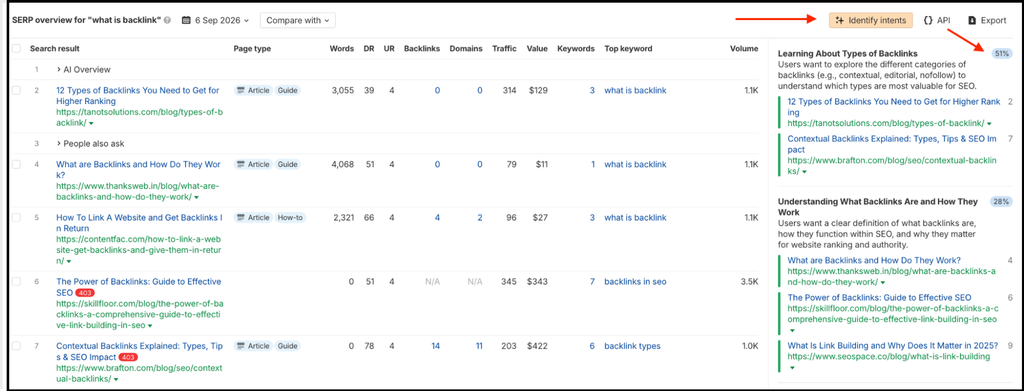
Identifying intents on Ahrefs
The same principle applies to AI search, where users often phrase these needs as longer, conversational questions.
Understanding the underlying question helps you create content that actually matches the searcher’s need.
7. Optimize content around relevant keywords and topics
Once you understand the searcher’s intent, use keywords to make your content easier to discover and understand. Start with a primary keyword or topic, then build around related terms, questions, and concepts that naturally belong on the page.
A white hat SEO approach means avoiding keyword stuffing. Use your primary keyword naturally in the title, H1, relevant subheadings, introduction, and body copy where it fits.
For AI visibility, turn the questions your audience is asking into relevant H2s, incorporating the target keyword naturally where appropriate. Then answer each question directly in the first few sentences beneath the heading.
This gives AI systems a clear, self-contained passage to interpret and potentially cite when responding to a related query.
8. Create helpful, valuable content
Helpful content should give readers a clear reason to choose your page over the many other results available.
Go beyond summarizing existing information by adding first-hand experience, original insights, examples, data, or useful analysis that helps the reader make a decision or solve a problem.
A useful way to evaluate your content is through Google’s “Who, How, and Why” framework:
- Who created the content? Make the author or source clear and establish relevant expertise.
- How was it created? Where relevant, explain the research, methodology, or use of AI and other tools.
- Why does the content exist? Its primary purpose should be to help people, rather than simply attract search traffic.
This also aligns with how people use AI search: they ask specific questions to solve problems, evaluate options, and make decisions. Content that directly addresses those needs, while adding genuine expertise and context, gives both readers and AI systems more substance to work with.
9. Build topical authority
Building topical authority starts with your primary query. Then, think about how a search system might fan out from that query to gather the information needed for a complete answer.
For instance, if your primary topic is SaaS SEO, related content could cover questions such as “How do you do keyword research for SaaS?”, “How do you build backlinks for SaaS?”, and “How do you measure SaaS SEO performance?”
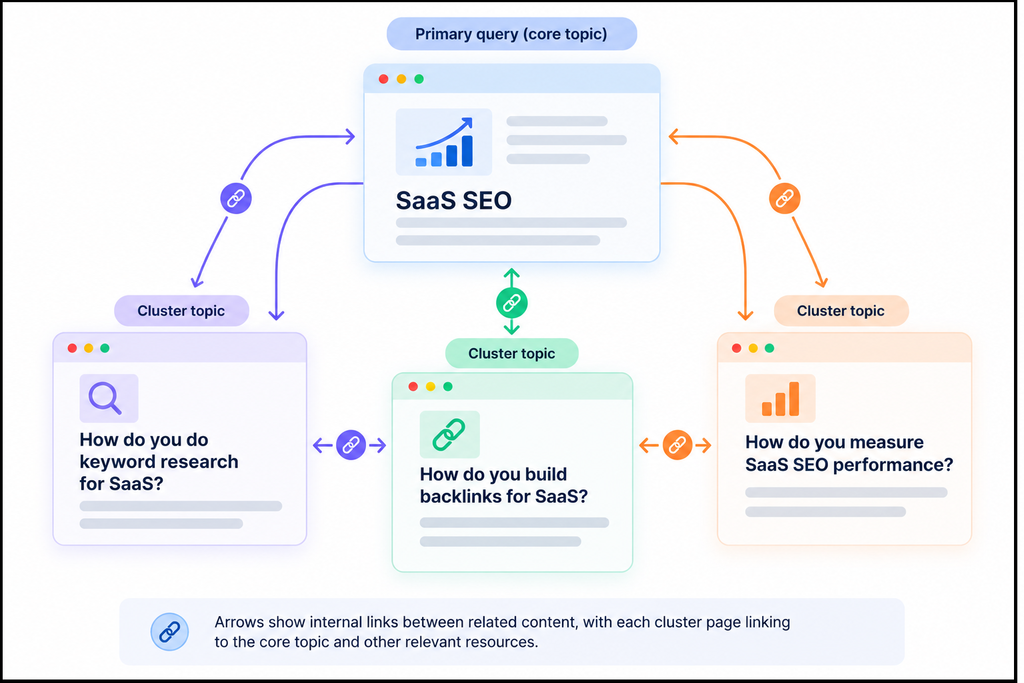
Connect these pages through internal linking, with supporting content linking back to your core topic and to other relevant resources.
Rather than publishing hundreds of disconnected articles, build a useful body of knowledge around the subjects your business is qualified to speak about.
10. Refresh content that has become outdated
Even strong content can lose its value as information, products, statistics, and best practices change.
As part of a white hat SEO strategy, regularly review your older pages to update outdated facts, replace old examples, add relevant developments, and remove information that no longer applies.
Pay particular attention to pages that still attract impressions or high-quality backlinks but have started losing organic visibility. Refreshing them can be more efficient than starting from scratch.
Besides, AI search systems pull a fresh set of pages from the web when generating an answer. So you may still have an opportunity to be cited even if your page isn’t ranking among the top 20 organic results.
Keeping your content current gives these systems a more relevant source to draw from.
11. Demonstrate first-hand expertise and trust (E-E-A-T)
Google’s E-E-A-T (Experience, Expertise, Authoritativeness, and Trustworthiness) framework helps explain what makes content credible and valuable.
These qualities also give AI search systems stronger signals when evaluating whether a website is a reliable source. Demonstrate E-E-A-T through the content itself rather than simply claiming expertise.
The need for strong E-E-A-T is even greater for YMYL (Your Money or Your Life) topics, which can affect people’s health, finances, safety, or well-being. Show relevant expertise, cite reliable sources, and keep information accurate and up to date.
12. Earn high-quality, relevant backlinks
As search evolves and AI tools like ChatGPT, Perplexity, and Gemini reshape how people discover information, backlinks remain an important signal of your website’s credibility.
Links from established sites in your industry can strengthen your authority and help search systems place your brand within its subject area.
Focus on earning editorial links where the placement makes sense for both the publisher and its readers. Avoid tactics such as link farms, private blog networks (PBNs), excessive link exchanges, paid links designed to manipulate rankings, and low-quality directories.
Google uses systems such as SpamBrain to detect and neutralize unnatural links created primarily to manipulate search rankings.
13. Earn brand mentions and digital authority
Your brand’s presence across the wider web can help search and AI systems understand what your business is known for. An Ahrefs study of 75,000 brands found that brand web mentions had the strongest correlation with AI Overview visibility (0.664).
You can build these signals by:
- Contributing expert commentary to industry publications
- Getting featured on relevant podcasts and webinars
- Publishing original research and data others can reference
- Participating in relevant industry communities and discussions
- Building partnerships that naturally generate brand mentions
Check out our detailed guide on how to earn brand mentions that can help your brand get cited by LLMs.
Final Thoughts
White hat SEO works best when the individual tactics support one another. Technical SEO helps search engines access your site, while your content gives them something worth surfacing. External signals such as backlinks and brand mentions then extend your presence beyond your own website.
The key is to build these signals around the pages and topics that matter to your business rather than treating SEO as a checklist of isolated tasks.
At Tanot Solutions, we take this strategy-led approach to link building, focusing on relevant websites, genuine authority, and real traffic.
Need help building a stronger backlink profile? Talk to us about your SEO goals.