
A backlink gap analysis helps you find websites that link to your competitors but not to your website. Instead of relying on guesswork, you can use those insights to build a focused list of high quality outreach opportunities that support your link building strategy.
In this guide, you’ll learn how to choose the right competitors, compare referring domains, review each opportunity, and organize the results using a free spreadsheet template. You’ll also see where AI can help speed up research and outreach planning , without replacing manual review of each website and opportunity.
What a Backlink Gap Analysis Shows You
A backlink gap is the difference between the websites linking to your competitors and those linking to your site. If a relevant publication links to several competitors but not to your site, it may represent a valuable outreach opportunity.
However, not every missing link is worth pursuing. Focus on websites with a relevant audience and a reasonable reason to mention your page, resource, product, or research.
A backlink gap analysis can be performed at both the website and page level:
- Compare entire websites to understand the types of publications and resources supporting your competitors across their sites. This gives you a wider pool of potential link opportunities.
- Compare individual pages when you want to improve the rankings of a specific service page, product page, or guide. For example, if your guide ranks below competing guides for the same topic, check which sites link directly to those competing pages and why they earned those links.
Keep the analysis focused on quality over quantity. At Tanot Solutions, we follow the same principle in our link building campaigns: prioritizing relevant, editorially earned backlinks that support business goals rather than simply increasing link volume.
What you Need for Backlink Gap Analysis
Before you open a backlink tool, gather the information you’ll need to make the comparison meaningful.
1. Choose your target
Start by deciding what you want to improve. This could be:
- Your entire website to uncover broad link opportunities.
- A specific service page, product page, or guide that needs stronger authority.
Having a clear goal keeps your analysis focused and prevents you from collecting irrelevant prospects.
2. Identify the right competitors
Search your primary keyword and a few close variations, then note the websites that consistently rank for the same search intent. Most backlink gap analyses work best with three to five competitors.
Avoid comparing your site with unrelated brands, large publishers, directories, or marketplaces simply because they rank well. For example, a B2B SaaS company shouldn’t model its link building strategy on Wikipedia because it ranks for a broad topic. Instead, focus on competitors serving the same audience with similar products or content.
3. Collect the backlink data
Export the referring domains for your website and each competitor into a single spreadsheet. Keeping everything in one place makes it easier to remove duplicates, compare referring domains, prioritize prospects, and track outreach.
4. Use one tool for a fair comparison
Free backlink monitoring tools and trial accounts provide a useful starting point, but no single platform discovers every backlink. Different providers use different crawlers and update their indexes at different speeds, so backlink totals often vary.
Semrush’s backlink database study shows why backlink totals can vary between tools.
To keep your analysis consistent, use the same tool and the same settings for your website and every competitor. This ensures you’re comparing like with like rather than different backlink databases.
How to Do Backlink Gap Analysis
A backlink gap analysis involves three key steps: exporting competitor backlink data, identifying websites that don’t link to you, and reviewing each opportunity before starting outreach. Focus on referring domains rather than total backlinks, as unique websites linking to your competitors provide a better indication of potential outreach opportunities.
Step 1: Export referring domains for each competitor
Start by exporting the referring domains for your website and each competitor using the same backlink tool. Include fields such as:
- Referring domain
- Source page
- Linked page
- Anchor text
- Follow/Nofollow status
- Authority metrics (if available)
Use the same comparison scope throughout. If you’re comparing entire websites, export data for each root domain. If you’re analysing a specific page, export backlink data for the exact URL across all competitors.
To begin with, you can use Ahrefs’ Link Intersect tool for backlink gap analysis. Enter your website in the “But doesn’t link to” field and add up to three competitors in the comparison fields. Ahrefs will automatically show websites that link to your competitors but not to you.
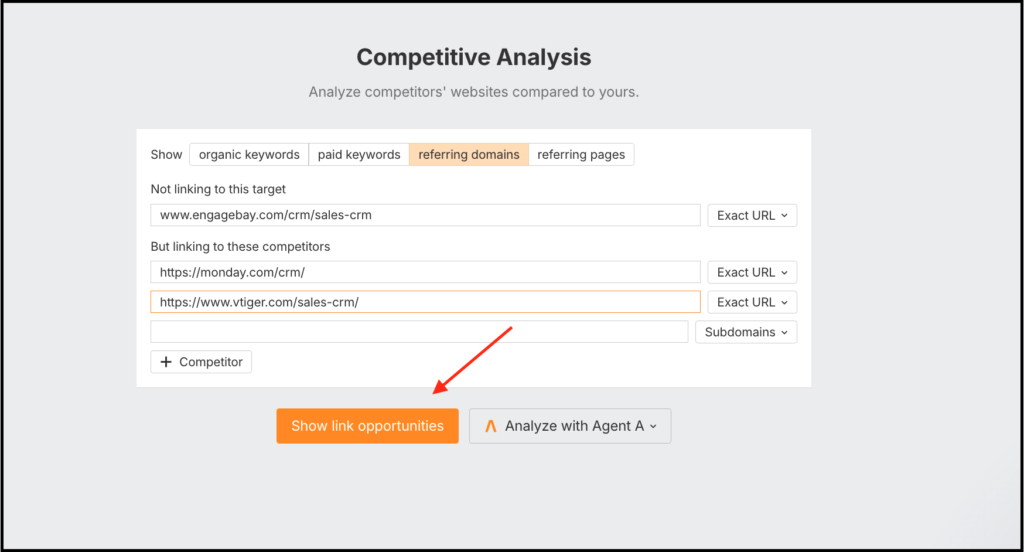
Ahrefs’ Link Intersect tool to compare your page with competing pages
Then, export the referring domains for your website and each competitor using the same scope. These exports provide the data you’ll use to compare backlink profiles and identify missing opportunities.
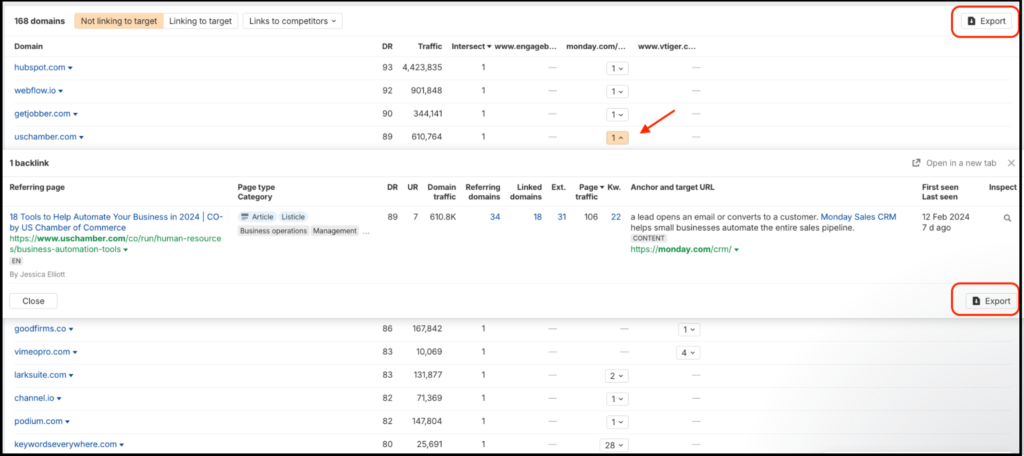
Step 2: Find the websites that don’t link to you
Once you’ve exported the data, clean each list by removing duplicate entries, protocols (https://), www, and URL paths.
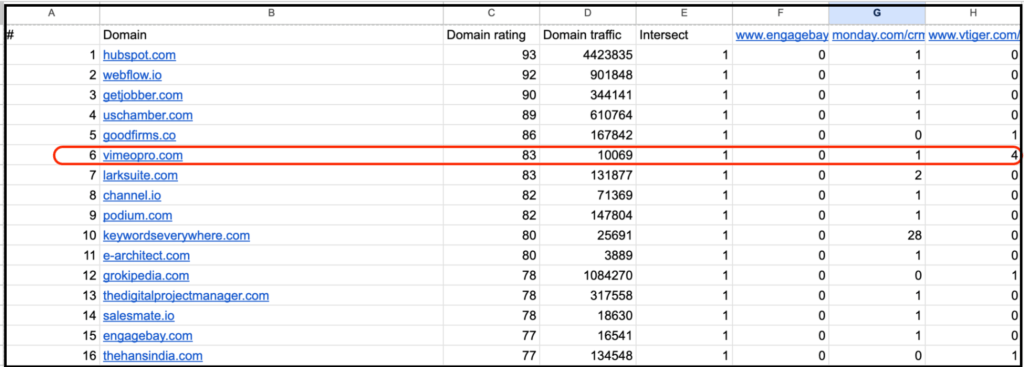
Next, compare the competitor lists against your own referring domains using XLOOKUP or COUNTIF in Google Sheets or Excel. This quickly identifies websites that link to one or more competitors but not to you.
Prioritize publishers linking to multiple competitors, as they’re more likely to cover your industry and be open to referencing similar resources.
If Monday CRM and Vtiger receive backlinks from the same industry blog, but your CRM page doesn’t, that publisher becomes a strong outreach opportunity.
Avoid websites built primarily for selling backlinks, including PBNs, low-quality directories, and fake publisher networks.
Step 3: Review why the competitor earned the link
Before adding a website to your outreach list, open every promising source page. Check whether the page is still live, useful, relevant to your topic, and maintained for a real audience.
Look at the reason for the earned backlink as well. The competitor may have been cited in a research article, a resource list, a comparison, a news story, a product review, or a broken-link replacement.
Understanding the context helps you determine whether your own content fills the same need, or whether you need to create a better resource before reaching out.
For instance, if a publisher links to your competitor’s original research, sending outreach for a generic blog post is unlikely to succeed. However, if you have more recent data or a stronger resource on the same topic, you have a credible reason to request consideration.
Use the Free Backlink Gap Analysis Template
Once you’ve identified promising backlink opportunities, record them in a spreadsheet before starting outreach. A structured template makes it easier to compare publishers, prioritize high-value opportunities, assign ownership, and track progress throughout your campaign.
The Google Sheets template below includes the key fields you’ll need to evaluate every prospect consistently.
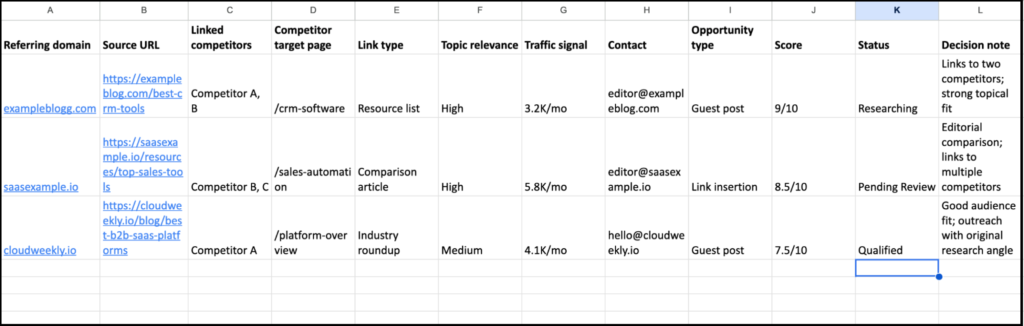
Google Sheets backlink gap analysis template
Each row represents one backlink opportunity and records details such as the referring domain, source URL, competitors receiving the backlink, the page they linked to, the type of backlink, topical relevance, and estimated traffic.
In the template above, exampleblogg.com links to Competitors A and B through a resource list and has high topical relevance, making it a strong outreach opportunity. cloudweekly.io currently links to only one competitor and has medium topical relevance, so it may be worth reviewing after higher-priority opportunities.
Rather than relying on a single authority metric, evaluate whether the publisher is relevant to your audience, maintains editorial quality, attracts organic traffic, and has a genuine reason to reference your content.
Score each opportunity
Not every backlink opportunity deserves the same amount of effort. Add a Priority Score column to your spreadsheet and score each opportunity against these five factors:
- Topic relevance
- Editorial quality
- Organic visibility
- Number of competitors the website links to
- Strength of your outreach angle
Assign 0 to 2 points for each factor, giving every opportunity a maximum score of 10.
| Referring domain | Priority score | Why? |
| exampleblogg.com | 9/10 | Links to two competitors, highly relevant topic, and a resource list provides a strong outreach angle. |
| saasexample.io | 8.5/10 | Comparison article with good traffic and multiple competitor links, but slightly narrower topical focus. |
| cloudweekly.io | 7.5/10 | Relevant website but links to only one competitor and has medium topical relevance. |
Track the status of every opportunity
Once you’ve prioritized your link prospects, add a Status column to monitor progress throughout your outreach campaign.
Use simple statuses such as:
- Pending Review
- Researching
- Qualified
- Contacted
- Negotiating
- Live
- Declined
- Not a fit
For example, exampleblogg.com may move from Review to Researching while you evaluate the opportunity and develop an outreach angle, whereas cloudweekly.io may already be in the Qualified stage after meeting your relevance and quality criteria.
Finally, include a Decision Notes column to record why an opportunity was approved, rejected, or deprioritized. This creates a clear audit trail, prevents duplicate outreach, and makes it easier for your team to review decisions before any link goes live.
💡AI Tip: Use AI to Prioritize Outreach
Once you’ve completed your backlink gap analysis, upload your spreadsheet to ChatGPT or Claude and ask it to evaluate your opportunities based on topical relevance, editorial quality, traffic potential, competitor overlap, and outreach potential.
Example prompt:
I’ve completed a backlink gap analysis and shortlisted potential outreach opportunities. Review the spreadsheet and score each website based on:
– Topical relevance to my business
– Editorial quality and credibility
– Organic traffic potential
– Number of competitors receiving backlinks
– Likelihood of earning a backlink
For each website, explain your reasoning, assign a priority score out of 10, identify any red flags, and recommend the best outreach angle (e.g., guest post, resource page, original research, product mention, or broken link replacement). Finally, rank the opportunities from highest to lowest priority.
Remember: AI can help organize data, identify patterns, and suggest outreach angles, but it cannot replace manually reviewing the publisher’s website, audience, editorial standards, and the context of the existing backlink before you reach out.
Tools You Can Use For Backlink Gap Research
In the section above, we used Ahrefs to demonstrate how to compare competitors, identify backlink gaps, and export referring domains. You can follow the same workflow with other backlink analysis tools, provided you use the same platform and comparison settings throughout your research to keep the results consistent.
Popular alternatives include:
- Semrush – Competitor backlink analysis and Backlink Gap reports.
- Moz Link Explorer – Referring domains, anchor text, and backlink research.
- Majestic – Historical backlink data and topical trust signals.
- Google Search Console – Review backlinks Google has discovered for your own website.
- Google Search – Find resource pages, publisher guidelines, expert roundups, and brand mentions for outreach.
Different tools maintain their own backlink indexes and crawling schedules, so it’s normal to see variations in backlink counts. Treat these numbers as research signals rather than an exact count of every backlink.
Regardless of the tool you choose, always review the source page manually before reaching out. The quality of the page, its audience, editorial standards, and the context of the existing backlink are far more important than any third-party SEO metric.
Backlink Gap Analysis Checklist
Choose the website or page you want to improve.
Define the target topic and search intent.
Select 3–5 relevant competitors ranking for the same searches.
Export backlink data using the same tool and comparison scope.
Remove duplicate domains and websites that already link to you.
Prioritize publishers linking to multiple competitors.
Review each source page for relevance, editorial quality, and outreach potential.
Record the competitor page and why it earned the backlink.
Score and prioritize opportunities using your backlink gap analysis template.
Assign an owner, outreach status, and next action for every prospect.
Track live backlinks, rankings, referral traffic, and business impact.
Tip: Repeat the analysis quarterly or after major content, product, or website updates. A fresh comparison can reveal new competitors, new resources, and new opportunities that were not visible in earlier data.
Build a Better Opportunity List, Not a Bigger One
A well-executed backlink gap analysis does more than uncover missing backlinks. It helps you identify the publishers that matter, understand why your competitors earned those links, and focus your outreach on opportunities that align with your business goals.

Rather than chasing every missing backlink, prioritize relevant, editorially credible websites where your content genuinely adds value. This approach not only supports long-term Google rankings but also strengthens the authority and trust signals behind the pages that AI-powered search experiences, such as AI Overviews, ChatGPT, and Perplexity, may reference.
At Tanot Solutions, backlink gap analysis is an integral part of our link building strategy. We combine competitor research, manual prospect qualification, and editorial outreach to help SaaS, B2B, ecommerce, and enterprise brands earn high-quality backlinks that drive measurable organic growth and not just higher link counts.
Ready to uncover your best link opportunities? Contact us today to build a data-driven link building strategy that turns competitor insights into sustainable SEO growth.