Anchor text is the clickable text used to link one webpage to another. It allows readers, search engines, and AI-powered systems to understand the relationship between the linked pages.
But not all anchor text works the same way. Depending on the wording you use, an anchor can reinforce a target keyword, strengthen brand associations, provide contextual relevance, or simply direct users to another resource.
Understanding the different types of anchor text can help you build more natural internal links and evaluate backlinks more strategically.
💡 Key Takeaways
- There are seven common types of anchor text: exact match, partial match, branded, naked URL, generic, related/semantic, and image anchors.
- No single anchor text type is universally “best.” A natural link profile uses a mix of relevant anchors.
- Exact-match anchors can reinforce keyword relevance, but repeatedly forcing the same keyword into backlinks can make a link profile look unnatural.
- For external links, relevance, editorial context, and the quality of the referring website matter alongside anchor text.
- Internal and external links can use different anchor text approaches depending on their purpose.
What Are the Different Types of Anchor Text?
Anchor text can take several forms depending on what appears between the opening and closing link tags.
Here are the seven types of anchor text you’re most likely to encounter.
1. Exact-match anchor text
Exact-match anchor text uses the target keyword exactly as it appears on the page you’re linking to.
Example: In the screenshot below, “backlink monitoring tools” is used as the anchor text, linking directly to Tanot Solutions’ page targeting that same keyword.

Here, the anchor text matches the target keyword word-for-word. It can be useful for internal linking when the keyword fits naturally into the sentence.
The same principle applies to external backlinks, but with more caution. Deliberately building large numbers of backlinks using the same exact-match keyword can make your link profile appear engineered.
Don’t avoid exact-match anchors altogether. Use them where they make contextual sense rather than forcing a keyword into every link.
2. Partial-match anchor text
Partial-match anchor text includes the target keyword but adds other words or modifies the phrase.
Example: In the screenshot below, “services like link building” is used as the anchor text, linking to Tanot Solutions’ service page about link building.

Here, “link building” is the target keyword, while “services like” adds additional words around it. This makes the anchor a partial match rather than an exact match.
The anchor also fits naturally within the surrounding sentence, which discusses performance reports and specific SEO services. The result is a more natural way to reference the target topic without repeating the exact-match phrase.
Partial-match anchors can also add useful variation to a backlink profile. Instead of repeatedly using the same keyword or phrase, publishers can reference a page using different but relevant wording.
3. Branded anchor text
Branded anchor text uses a company, product, website, or brand name as the clickable text.
Example: In the screenshot below, “Tanot Solutions” is used as the anchor text and links to the Tanot Solutions homepage.

The anchor doesn’t include a target keyword, such as ‘SEO agency’ or ‘link building services.’ It simply uses the brand name to identify the company being referenced.
Branded anchors commonly appear when publishers mention a business, product, or service provider in editorial content. In this example, the article is discussing niche agencies that focus on SEO and link building, making the brand mention relevant to the surrounding context.
They can also contribute to a natural backlink profile because businesses are frequently referenced by name rather than through keyword-focused anchor text.
4. Naked URL anchor text
A naked URL anchor uses the actual webpage address as the clickable text.
Example: In the screenshot below, “tanotsolutions.com” is used as the anchor text and links to the Tanot Solutions website.
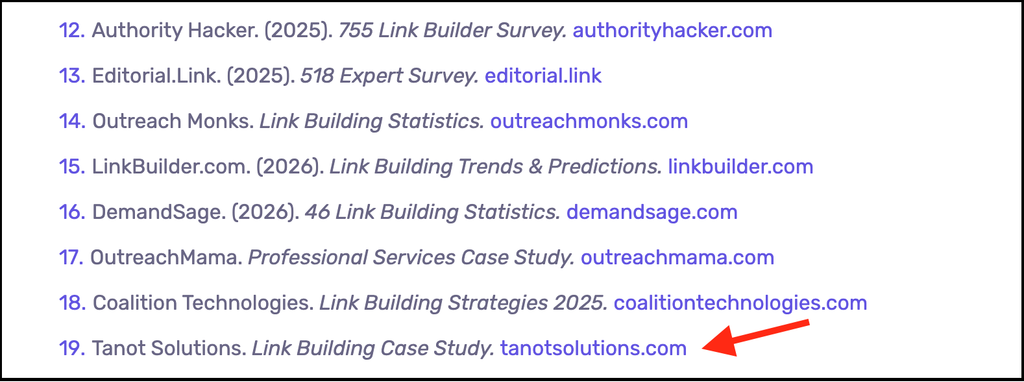
Unlike a branded anchor, which uses the company name as the clickable text, a naked URL displays the website address itself. The URL is clear, recognizable, and serves its purpose without needing additional keyword optimization.
Naked URLs are common in citations, resource pages, references, forums, and other situations where the website address itself is being shared.
They don’t provide as much descriptive context as a keyword-rich anchor, but that’s not necessarily a problem. Links don’t need to contain keywords to be useful.
5. Generic anchor text
Generic anchor text uses broad phrases that don’t specifically describe the destination. Common examples include:
- Learn more
- Read more
- Click here
- Visit this website
- Find out more
Example: In the screenshot below, “Visit Website” links to the Tanot Solutions homepage.

The anchor itself doesn’t tell readers what the linked website is about. Instead, they have to rely on the surrounding content to understand why the link is relevant.
Generic anchors are often used as calls to action or when the surrounding copy already provides enough context about the destination.
The key is not to treat every generic anchor as a problem that needs replacing with a keyword. Anchor text should ultimately serve the reader and fit naturally within the content.
6. Related / Semantic anchor text
Related or semantic anchor text uses a phrase that is closely connected to the target topic without exactly matching the primary keyword.
Example: In the screenshot below, “SEO for organic visibility” links to the Tanot Solutions homepage.

The phrase doesn’t contain the exact target keyword, but it is still closely related to the subject.
The article discusses lead generation and how SEO can contribute to organic visibility, making the anchor relevant to the surrounding context. Tanot Solutions provides link building services as part of a broader SEO strategy, which can ultimately help businesses improve their organic visibility and generate more qualified leads.
This type of anchor can provide useful contextual variation while avoiding repetitive keyword targeting. It is particularly helpful when the exact keyword would sound awkward or forced in a sentence.
As search systems increasingly interpret content through broader context and relationships between topics, using naturally related language can also help strenngthen the connection between the linked page and the subject being discussed.
7. Image anchor text
When an image is used as a link, its alt text can serve as the descriptive text associated with that link.
Example: Imagine an infographic about backlink strategies that links to a detailed guide. Instead of using text such as “read more,” the image could have descriptive alt text explaining what it represents.
Image links can be useful when a visual asset naturally leads users to another resource. However, alt text should primarily describe the image accurately and help users who cannot see it. It shouldn’t be stuffed with keywords simply to influence anchor text.
Best Use Cases for Different Types of Anchor Text
| Type | Best Use Case |
| Exact-match anchor text | When the target keyword fits naturally |
| Partial-match anchor text | Adding contextual relevance |
| Branded anchor text | Brand mentions and citations |
| Naked URL anchor text | Citations and references |
| Generic anchor text | Natural CTAs |
| Semantic anchor text | Adding topical variation |
| Image anchor text | Links from images |
Which Type of Anchor Text Is Best for SEO?
There isn’t one “best” type of anchor text. A natural backlink profile uses variation based on the context of each link. The right approach also depends on whether you’re linking to another page on your own website or earning a backlink from an external website.
For internal links
Internal links connect pages within your own website. Since you control the wording, you can be more deliberate about making the anchor descriptive and useful.
For example:
- Use descriptive exact- or partial-match anchors when they fit naturally.
- Make the destination clear to the reader.
- Vary anchor text where appropriate.
- Avoid repeatedly forcing the same keyword into every internal link.
If a page discusses link building strategies, an anchor such as link building metrics can be more useful than a generic “click here” because it tells readers what to expect after clicking.
For external backlinks
External backlinks require a different approach because you don’t always control how another publisher references your website.
A natural backlink profile can contain different anchor types depending on how publishers reference your brand and content.
Instead of trying to manufacture a specific anchor text ratio, focus on the quality and context of the link itself.
- Is the referring website relevant?
- Is the link placed naturally within editorial content?
- Does the page receive real traffic?
- Does the link make sense for the reader?
This is why link building shouldn’t be reduced to chasing a particular anchor text percentage. The anchor is only one part of the backlink.
At Tanot Solutions, we evaluate link placements for relevance, anchor text, and brand alignment before they go live. This means checking that the anchor naturally fits the surrounding content and accurately reflects the linked page. Every backlink is also client-approved, giving businesses greater control over the quality and context of the links they acquire.
Common Anchor Text Mistakes to Avoid
A few common mistakes can make anchor text less useful or make your link building strategy unnecessarily complicated:
- Repeating the same exact-match anchor: Using one keyword across a large number of external backlinks can make your profile look overly optimized.
- Forcing keywords into sentences: If an anchor sounds unnatural to a reader, changing it just to include a target keyword probably isn’t worthwhile.
- Treating generic anchors as harmful: “Learn more” or “read more” isn’t automatically a bad anchor. Context matters.
- Ignoring the surrounding content: A relevant anchor on an irrelevant page is still a weak link.
- Focusing only on anchor text: The relevance, authority, editorial context, and actual traffic potential of the referring page matter too.
- Chasing an “ideal” anchor text ratio: There is no universal percentage that works for every website or backlink profile.
Final thoughts
The different types of anchor text each have a role to play. Exact-match and partial-match anchors can reinforce topical relevance, branded anchors strengthen brand associations, and generic or naked URL anchors can occur naturally across citations and references. Semantic and image anchors add further variation.
The goal isn’t to engineer a perfect anchor text profile. It’s to build links that make sense in context, help users navigate the web, and support your broader SEO strategy.
If you need help building high-quality, contextually relevant backlinks, contact Tanot Solutions to discuss your link-building goals. Book a free call today.