Anchor text might look like a small detail in a link, but the words you choose can influence how users and search engines understand the page you’re linking to. Whether you’re adding internal links to your own content or earning backlinks from other websites, the right anchor text can provide useful context without making your links feel forced.
Google describes good anchor text as descriptive, reasonably concise, and relevant to both the page it appears on and the page it links to. It also recommends writing naturally rather than cramming keywords into link text.
In this guide, we’ll explain what anchor text is, the different types you may encounter, and how to choose anchor text that supports a natural, relevant SEO strategy.
💡 Key Takeaways
- Anchor text is the visible, clickable text used in a hyperlink and helps users and search engines understand the linked page.
- Descriptive, relevant anchor text can improve context, navigation, and user experience across both internal and external links.
- There are six common types of anchor text, including exact-match, partial-match, branded, naked URL, generic, and image anchor text.
- Effective anchor text should match the destination page, fit naturally within its surrounding content, and vary based on context.
- For external links, anchor text is only one part of the picture. The relevance, quality, authority, and context of the linking page also matter.
What Is Anchor Text?
Anchor text, also called link text, is the visible and clickable text within a hyperlink. Here’s what it looks like:
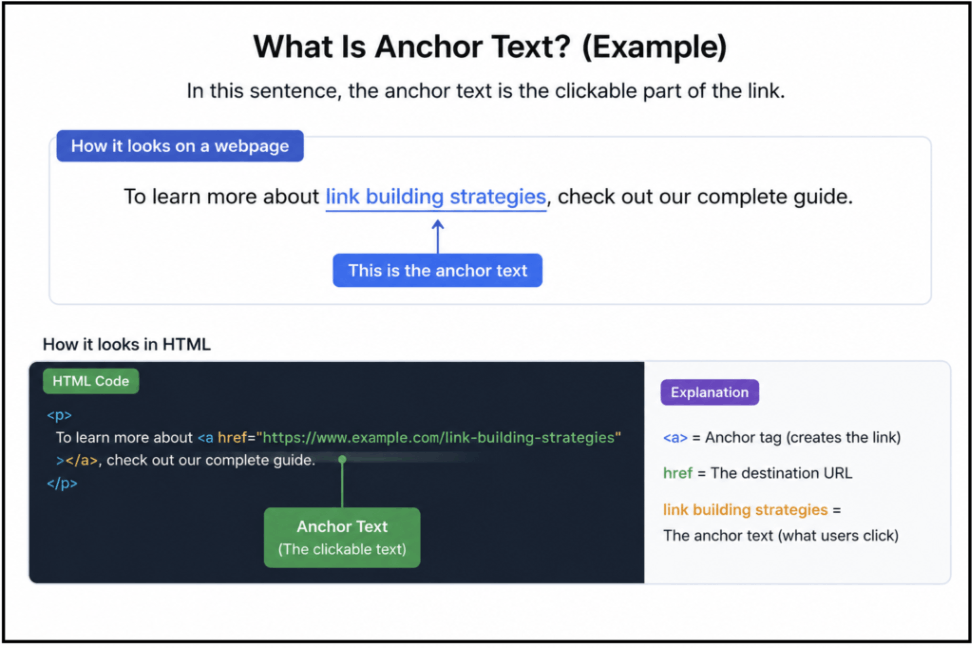
In this example, link building strategies is the anchor text, while the link itself points to the destination page.
Anchor text helps readers understand what to expect when they click a link, while also giving Google context about the page it points to.
The same contextual signals also matter for AI-powered search experiences. AI search systems need to interpret relationships between pages, topics, entities, and sources to determine which information is relevant to a query.
💡Anchor text should accurately describe the destination and fit naturally into the sentence around it.
Why Is Anchor Text Important for SEO?
Anchor text helps connect related pages and gives both users and search engines more context about those connections. When Google crawls and indexes pages, it can use link text to better understand the topic and relevance of the page being linked to.
For internal links, descriptive anchor text helps Google understand how pages on your website relate to each other while making it easier for visitors to navigate to relevant resources. It’s the same for external links. Anchor text used for external links provides context about the linked content.
Besides, descriptive anchor text also improves the user experience by telling readers what to expect when they click a link. This is why optimizing anchor text isn’t about inserting as many target keywords as possible. Google specifically advises against forcing keywords into anchor text and says keyword stuffing can violate its spam policies.
6 Types of Anchor Text
Anchor text can take several forms depending on how the link is written.
- Exact-match anchor text
Uses the exact keyword or phrase you’re targeting. For example, link building services could be an exact-match anchor for a page targeting that term.
- Partial-match anchor text
Includes part of the target keyword alongside other words. For example, “strategies for effective link building” could partially match the keyword “link building.”
- Branded anchor text
Uses the brand name as the link text. For example, Tanot Solutions could link to the company’s homepage or a relevant service page.
- Naked URL
Uses the URL itself as the clickable text, such as https://tanotsolutions.com/.
- Generic anchor text
Uses broad phrases that don’t describe the destination in much detail, such as click here, learn more, or read more.
- Image anchor text
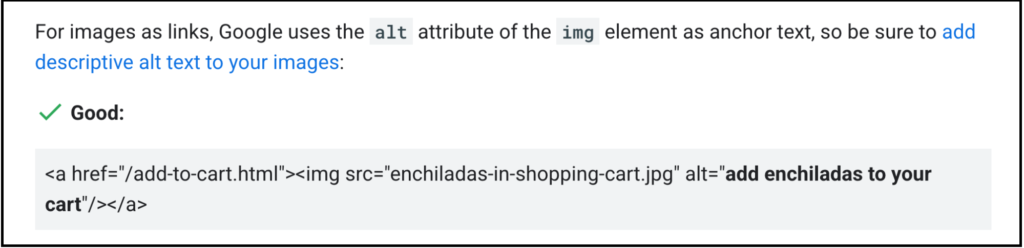
When an image is used as a link, Google can use the image’s alt text as anchor text. This makes descriptive, relevant alt text particularly important for linked images.
How to Optimize Anchor Text for SEO : 4 Best Practices
The right anchor text can make a difference to your SEO performance. Here are four practices for creating effective anchor text:
1. Match the anchor to the destination page
Start by looking at the page you’re linking to and choose anchor text that accurately reflects its content.
For example, the screenshot below shows a link to Tanot Solutions’ guide on where to buy high quality backlinks. The anchor text, “high quality backlinks,” fits naturally within the sentence and accurately describes the destination page.

This doesn’t mean your anchor text always needs to exactly match the target page’s primary keyword. You can also use a descriptive or partial-match phrase when it fits the context better.
A mismatch can be confusing for users and provide less useful context about the destination. For example, using “SEO services” to link to a page that only explains backlink metrics wouldn’t accurately describe what readers will find after clicking.
💡The key is to avoid creating a disconnect between what the anchor promises and what the linked page actually delivers.
2. Pay attention to anchor placement
Where you place a link matters just as much as the words you use for it. Links should appear where they are useful to readers and naturally fit within the surrounding content.
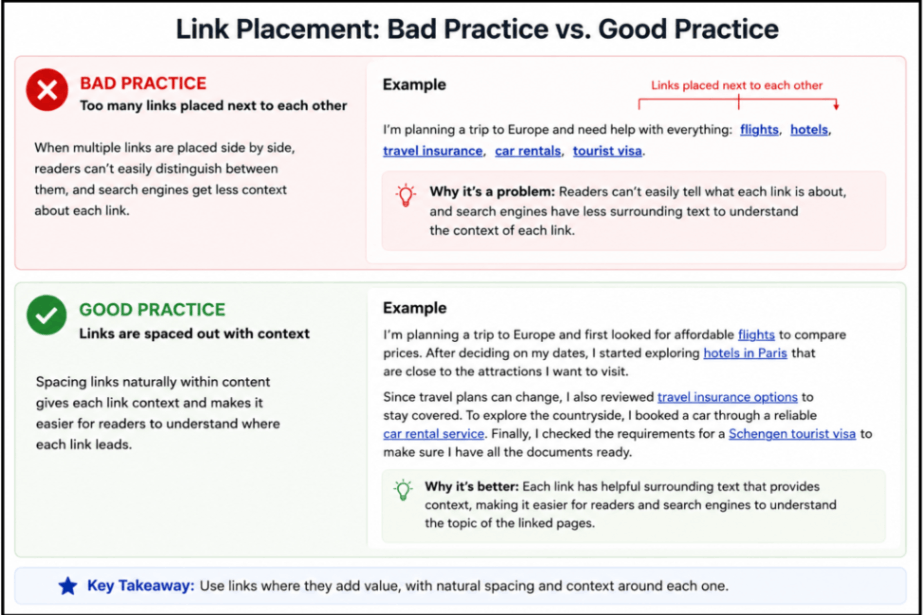
Google recommends paying attention to the words before and after a link rather than treating the anchor as an isolated element. It also advises against placing multiple links directly next to each other, as this can make it harder for readers to distinguish between them and removes the surrounding context that helps explain each link.
💡Avoid adding links simply because there’s an opportunity to insert one. Think about whether the link helps readers take the next logical step.
3. Vary your anchor text naturally
You don’t need to use the same anchor text every time you link to a particular page. Different pieces of content may naturally call for different descriptions of the same resource.
For example, the screenshot below shows different websites linking to Tanot Solutions’ link building service page using anchors such as “reputable link building agencies,” “link building services,” “creating links from reputable sites,” “link back to your site,” and “build backlinks.”
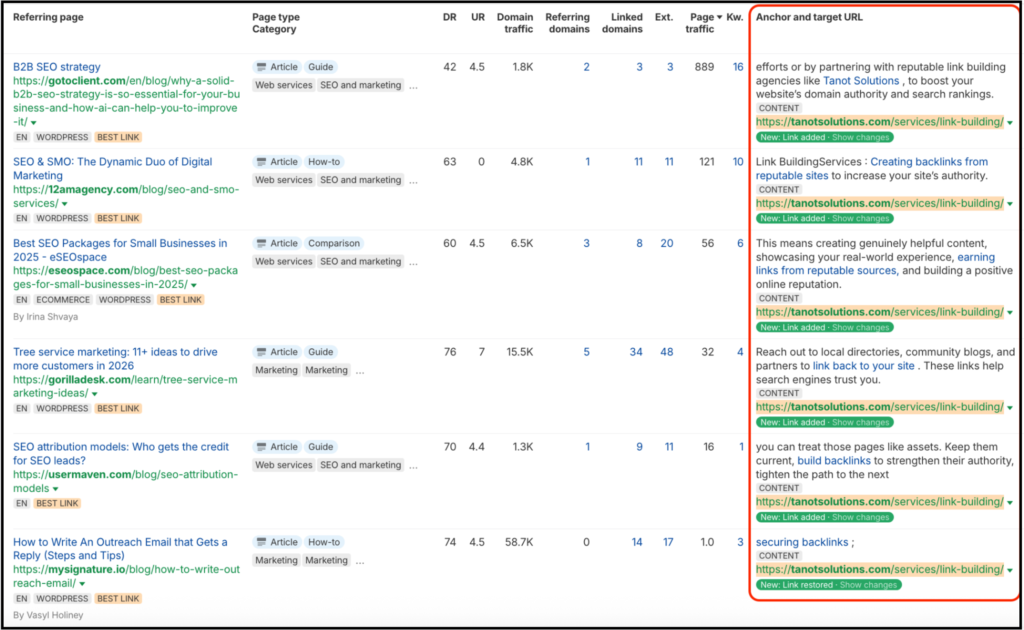
The destination remains the same, but the anchor text varies naturally based on how each referring page discusses link building. This is a useful example of why you don’t need to force one specific keyword into every link.
This applies to internal linking as well as external links pointing to your website. Different pages and publishers may describe the same resource in different ways, and that variation is natural.
💡Let the context determine the wording while keeping the destination and meaning clear.
| Is There an Ideal Anchor Text Ratio?There isn’t a universal ratio of exact-match, branded, partial-match, or generic anchors that every website should follow. Your anchor-text profile will depend on your content, brand, industry, and how links are acquired. Rather than trying to manufacture a specific percentage, focus on whether your anchor text is relevant, descriptive, and natural within its context. |
4. Don’t evaluate anchor text in isolation
Backlinks are one part of a broader SEO strategy, and anchor text is just one element of link building. So when evaluating anchor text, don’t look at the words alone. Consider the quality and relevance of the page where the link appears, too.
When evaluating an external link, consider:
- Relevance: Does the referring page cover a topic related to your website or the linked page?
- Authority: Is the website a credible source in its industry or niche?
- Context: Does the surrounding content naturally support the link?
- Referral traffic: Could the link put your website in front of a relevant audience?
- Editorial quality: Does the link genuinely add value to the content rather than appear forced?
This broader view is important because SEO isn’t about optimizing individual elements in isolation. Internal links, external links, content, technical factors, and other signals work together to help both traditional and AI search engines understand and evaluate a website.
For businesses investing in backlinks as part of their SEO strategy, Tanot Solutions assesses anchor text along with the relevance, authority, traffic potential, and contextual fit of each placement.
Every backlink is reviewed and approved by the client before it goes live, helping businesses build a backlink profile around quality and relevance rather than link volume.
Final Thoughts
Anchor text may be a small part of a page, but it plays an important role in helping users, traditional search engines, and increasingly AI-powered search experiences understand the relationship between linked pages. When combined with a strong overall SEO strategy, thoughtful anchor text can contribute to better navigation, stronger context, and a more useful website experience.
Looking to strengthen your SEO with strategic, high quality backlinks? Contact Tanot Solutions today to discuss your goals.