
A backlink from a reputable website can strengthen your brand’s visibility and authority. But what happens when that placement is paid for?
Sponsored links can provide valuable exposure and referral traffic, yet they’re not the same as earning an editorial backlink.
Google doesn’t discourage sponsored links. But do they pass SEO equity? Should you invest in paid links? And if you do, how can you make sure you’re paying for a placement that actually adds value?
The answer depends on the publisher, audience, placement, link attributes, and purpose behind the investment. Let’s look at how sponsored links work and where they fit into an SEO strategy.
💡 Key Takeaways
- Sponsored links are paid placements and should be clearly disclosed and appropriately qualified with rel="sponsored" or, where applicable, rel="nofollow".
- A sponsored placement shouldn't be treated as a substitute for an earned editorial backlink or a shortcut to ranking improvements.
- The value of a sponsored link can extend beyond SEO, including referral traffic, brand visibility, content discovery, and audience reach.
- Relevance, organic traffic, audience quality, editorial standards, and placement context matter more than domain metrics alone when evaluating a sponsored link.
- Sponsored link pricing can range from around $500 to $2,500 or more, depending on the quality and reach of the publisher.
- Sponsored placements work best when they complement, rather than replace, a broader authority-building strategy.
What Are Sponsored Links?
A sponsored link is a link placed on another website as part of a paid promotion, sponsorship, advertising arrangement, or similar commercial relationship.
Here’s what a sponsored placement can look like:
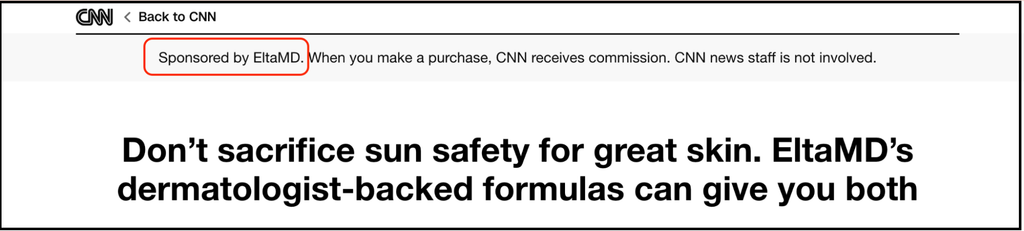
The example above shows a sponsored placement clearly labeled “Sponsored by EltaMD.” The disclosure makes the commercial relationship between the publisher and the brand clear to readers.
On blogs, news sites, and other publications, sponsored links may otherwise look like regular text links within an article. The distinction may not be visible on the page, but it can be reflected in the link’s HTML using the rel=”sponsored” attribute:

The attribute gives search engines additional context about the link’s commercial nature.
Understanding rel=”sponsored”, rel=”nofollow”, and rel=”ugc”
Google recommends rel=”sponsored” for links created as part of advertisements, sponsorships, or other compensation-based arrangements. rel=”nofollow” is also an acceptable way to qualify paid links, although Google recommends rel=”sponsored” for this purpose.
The three attributes serve different purposes:
- rel=”sponsored”: Used for advertisements, sponsorships, and other paid placements.
- rel=”nofollow”: Can be used when you don’t want to associate your site with a linked page or when a link doesn’t represent a typical editorial endorsement. It is also still acceptable for paid links.
- rel=”ugc”: Used for links within user-generated content, such as forum posts and comments.
For sponsored content, rel=”sponsored” is the most relevant attribute. It distinguishes a commercially placed link from a link a publisher has included as an independent editorial reference.
Do You Need Sponsored Links for SEO?
A paid placement can put your brand on a reputable website, but the backlink shouldn’t be treated the same way as an editorial link earned naturally.
If you’re paying primarily to acquire ranking value, a sponsored link isn’t a shortcut to higher rankings. Its value comes from the placement itself: who sees it, where it appears, and what that exposure can generate for your business.
A well-chosen sponsored placement can support your broader SEO strategy in several ways:
- Generate referral traffic: A placement on a relevant publication can send qualified visitors directly to your website.
- Increase brand visibility: Getting your company in front of an established audience can build awareness, particularly in competitive industries.
- Support content discovery: A sponsored article can introduce people to your research, tools, guides, or other resources they may later reference or share.
- Complement authority building efforts: Sponsored placements can work alongside digital PR, editorial link acquisition, brand mentions, and content marketing.
These are indirect benefits of the placement rather than evidence that the sponsored link itself is passing SEO equity.
So, should you invest in sponsored links?
It depends on what you want the placement to achieve.
If you’re buying sponsored links simply to increase your backlink count, there may be better ways to invest your SEO budget. But if the placement gives you access to a relevant audience and an opportunity to promote your brand or content, it can offer value beyond the backlink.
Before investing, ask:
“Would this placement still be valuable to my business without the backlink?”
If the answer is yes, it can help you avoid low-value placements and link farming tactics.
How to Choose the Right Sponsored Links
Not every paid placement is worth the investment. Instead of choosing a publisher based on the lowest price or highest domain rating, evaluate whether the website, audience, and specific placement are worth paying for.
Use these criteria when evaluating a sponsored placement:
- Prioritize relevance over domain metrics
Start with topical relevance. Look for publications that cover your industry, niche, or the topics your target audience cares about.
A website with a lower Domain Rating (DR) but strong topical relevance can be more valuable than a high-DR publication with little connection to your business.
- Check organic traffic and audience quality
A site’s SEO metrics don’t tell you whether people actually read its content. Check whether it attracts consistent organic traffic and whether that traffic is relevant to your business.
Tools such as Ahrefs and Semrush can help you assess organic traffic, top-performing pages, traffic sources, and keyword visibility. Look beyond the traffic number itself: 10,000 irrelevant visitors are less valuable than 2,000 potential customers.
- Review the website’s content quality
Read several recent articles before committing. Look for original, useful content and consistent editorial standards.
Be cautious if a website publishes dozens of sponsored articles across unrelated industries or appears to exist primarily for selling links. These patterns can be associated with PBN links and other low-quality link building practices designed primarily to manipulate search rankings rather than serve a genuine audience.
- Evaluate where your link will appear
A strong website doesn’t automatically guarantee a strong placement. Pay attention to the topic of the article, where your link will appear, and how naturally it fits within the content.
A relevant contextual link can provide a better experience for readers than one buried on an unrelated page or placed alongside numerous commercial links.
If possible, review the proposed article or placement before approving it.
- Understand exactly what you’re paying for
Before agreeing to a paid placement, clarify:
- Where the content will appear
- Whether the content is permanent or time-limited
- Who will create and publish the content
- How the commercial relationship will be disclosed
- How the link will be qualified
- Whether you can review the content before publication
Sponsored Link Evaluation Checklist
Before you pay for a placement, check:
Is the publication relevant to my industry or audience?
Does it have genuine organic traffic and readership?
Is the site’s content original and editorially credible?
Is my link placed naturally within relevant content?
Does the site avoid excessive sponsored content?
Are the disclosure and link attributes appropriate?
Are the placement terms and deliverables clear?
Tip: If a placement fails several of these checks, it’s probably not worth the investment.
How Much Do Sponsored Links Cost?
Sponsored link pricing varies considerably based on the publisher, audience, traffic, niche, authority, and type of placement. As a general benchmark, a sponsored placement can cost around $500 to $2,500, although prices can fall below or exceed this range.
You can find placements for considerably less, but a lower price doesn’t necessarily mean better value. A $50 or $100 placement may look attractive compared with a $1,000 placement, but the cheaper site may have little organic traffic, an irrelevant audience, weak editorial standards, or a business model built primarily around selling links.
In that case, you’re paying for a backlink rather than meaningful exposure.
Higher-priced placements may make sense when you’re gaining access to an established publication with:
- Strong organic visibility
- Consistent readership
- High editorial standards
- Industry credibility
- Potential for genuine referral traffic
However, a $2,500 placement isn’t automatically a better investment than a $500 one. The right price depends on what the placement can realistically deliver.
For example, consider two hypothetical placements:
Site A: $150, high DR, little relevant traffic, and content covering almost every industry.
Site B: $1,200, moderate-to-high authority, strong organic traffic, and an audience made up largely of your target customers.
If your goal is to reach potential customers and build brand visibility, Site B may offer significantly more value despite costing eight times as much.
💡The takeaway: Evaluate the opportunity, not just the price tag. A sponsored placement should be judged by the quality of the publisher, relevance of its audience, and potential business value, not by its cost or SEO metrics alone.
Final Thoughts
Sponsored links can play a useful role in a broader SEO and digital marketing strategy when placements are relevant, high quality, and compliant with Google’s guidelines.
Choosing the right publishers, evaluating traffic and relevance, and understanding how paid links should be qualified can make the difference between a worthwhile placement and an expensive link with little return.
At Tanot Solutions, we help businesses build high quality backlinks through a transparent, carefully vetted process. We evaluate potential placements based on factors such as relevance, authority, organic traffic, and editorial quality to help ensure your link building investment supports your broader growth goals.
With 5,000+ backlinks delivered and an 85%+ client retention rate, our approach is built around strategy, transparency, and long-term results.
Ready to invest in the right sponsored placement? Contact us to discuss your link building strategy.