
Link building without clear metrics is just expensive outreach.
In simple terms, link building metrics help you evaluate whether your efforts are actually working. And that goes far beyond simply monitoring domain rating (DR) while acquiring links. Multiple factors determine whether a backlink strengthens your authority or just inflates a report.
Backlinks still influence rankings, and increasingly, they shape how AI-driven search systems assess credibility and trust. But if you’re not measuring the right KPIs, you won’t know whether your link profile is building leverage or creating hidden risk.
At Tanot Solutions, our link building services are built around one principle: authority must translate into growth.
So let’s talk about the link building KPIs that actually matter.
Why Is Link Building Important?
You’ve probably heard the claim: “Backlinks are dead.” But that narrative doesn’t hold up under scrutiny.
The Link Spam Updates and broader AI-driven algorithm improvements eliminated bad backlink practices. Low-quality, irrelevant, and manipulative links lost value. While strategic, editorial, and relevant links retained their influence.
When reputable websites link to you, they act as third-party validation of your expertise. That validation helps search engines assess your site’s credibility and authority.
If your brand lacks trusted references across authoritative websites, your discoverability weakens—even if your on-page SEO is technically strong.
We explore this shift in more detail in our guide on whether backlinks are dead. The short answer: they’re not, but they have definitely matured.
And that’s exactly why measuring the right link building metrics matters more than ever.
7 Simple Link Building KPIs You Should Track
Let’s move away from jargon-heavy reporting dashboards and focus on metrics that genuinely indicate health and performance.
1. Domain Rating (DR)
Domain Rating (DR) is a metric developed by SEO tools like Ahrefs to estimate the overall strength of a website’s backlink profile. It is scored on a scale from 0 to 100 and is calculated based on the number of unique domains linking to a site, the authority of those domains, and how link equity flows across them.
In general, a higher DR suggests a stronger backlink profile, which can contribute to improved search engine rankings and greater organic visibility.
However, looking at a site’s DR alone is not enough. Like most third-party metrics, it can be manipulated and comes with limitations.
A high DR website without real traffic or topical relevance offers limited strategic value. In contrast, a slightly lower DR website with consistent organic visibility and strong industry alignment often delivers a stronger impact.
A good link building specialist will cross-check whether the website:
- Receives meaningful organic traffic
- Ranks for relevant keywords
- Aligns topically with your industry
DR should act as a filtering metric and not the final decision-maker.
2. URL Rating (UR)
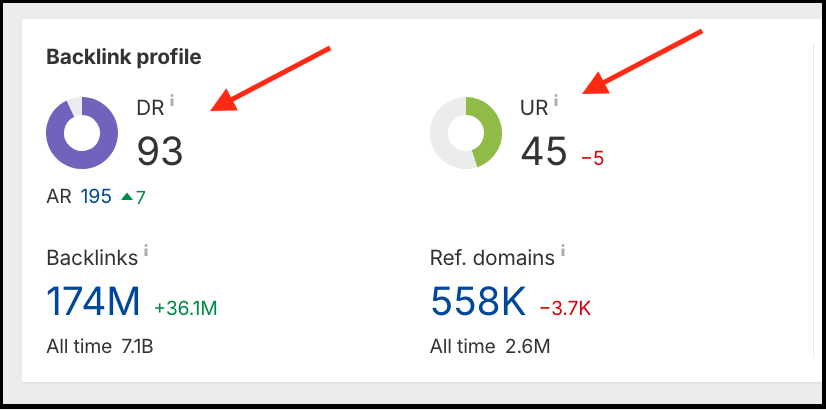
Many SEO campaigns focus heavily on domain-level metrics. However, the link you acquire lives on a specific page, and that distinction is critical.
URL Rating (UR), a metric used by Ahrefs, measures the authority of an individual page rather than the entire domain. It helps determine how much link equity that page can realistically pass to your website.
A domain may have a high DR, but if the linking page itself is not indexed, receives no organic traffic, or is buried deep within the site’s structure, the impact of that backlink will be limited.
Before securing a placement, evaluate whether the linking page:
- Is indexed and regularly crawled
- Ranks for relevant keywords
- Receives organic traffic
- Sits within a strong topical cluster on the website
Page-level strength often matters more than domain-level numbers. A contextual link from a well-ranking, traffic-generating page can deliver far more value than one from a powerful domain’s low-visibility corner.
In short, DR tells you about the building. UR tells you about the room your link lives in.
And in link building, that room matters.
3. Referring Domains vs. Backlinks Ratio
A referring domain is a unique website that links to your site, regardless of how many individual links it sends.
The backlinks-to-referring-domains ratio shows how many total links you receive from each unique website on average. In simple terms, it tells you whether your authority is coming from broad endorsement or repeated links from the same sources.
This metric is one of the clearest indicators of a natural link profile.
A healthy backlink profile shows diversity. When you see millions of backlinks coming from a relatively small number of referring domains, that usually signals sitewide links, template placements, or potentially manipulative patterns.
For example, we recently evaluated a website showing 5.5 million backlinks from just 45,000 referring domains. That imbalance indicates heavy repetition rather than broad endorsement.
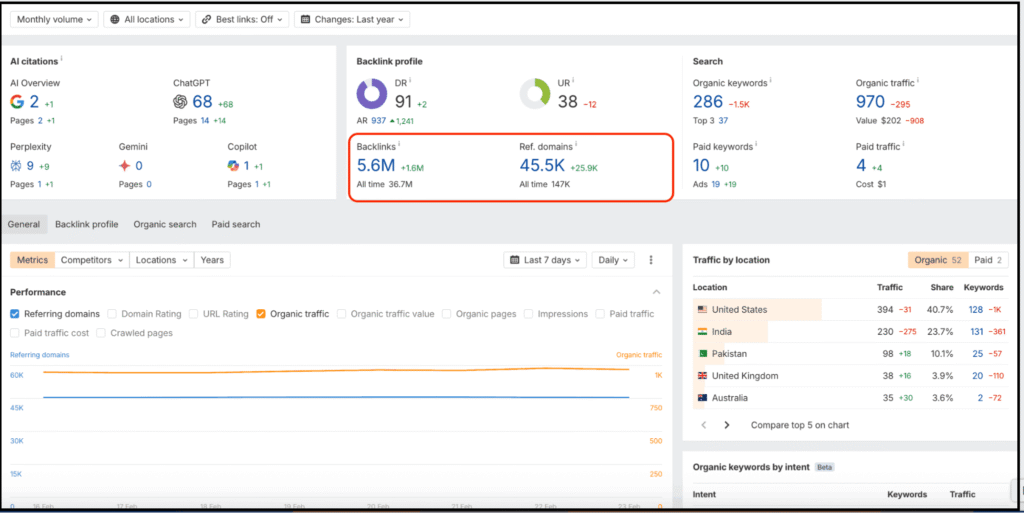
A healthier ratio typically falls around 1:10 or 1:20 (referring domains to total backlinks). While not a strict rule, extreme disparities should prompt a deeper review.
4. Organic Traffic Trends
One of the most reliable indicators of a strong backlink opportunity is stability.
At Tanot Solutions, we always analyze a site’s organic traffic trend before securing a link from it. A domain may show a high DR, but if its organic visibility has sharply declined or fluctuates unpredictably, that’s a red flag.
Websites with steep traffic drops after algorithm updates, irregular spikes, or prolonged downward trends often signal deeper issues, such as outdated content, link spam exposure, or loss of search trust.
When reviewing a site in Ahrefs, look at the organic traffic graph carefully. A healthy link source typically shows:
- Gradual and steady growth
- Stability across core updates
- Consistent keyword rankings over time
On the other hand, a volatile or declining graph suggests weakening authority.
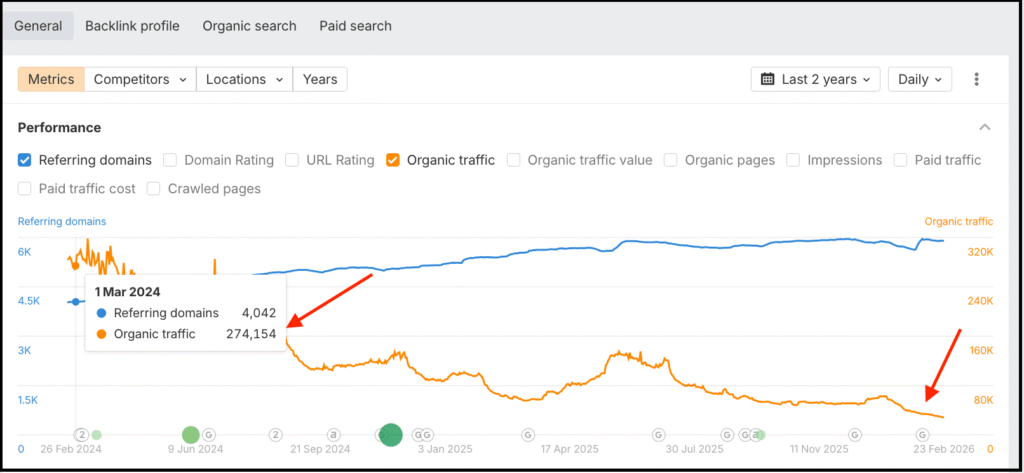
Organic traffic dropping from 274K to 60K within two years; a clear sign of declining visibility
Link building is less about borrowed authority and more about strategic brand association with trusted sources. If a site’s visibility is eroding, the long-term value of that backlink may be limited.
5. Position of Links on the Page
Not all links carry equal weight.
Search engines evaluate placement context. A link embedded naturally within relevant editorial content typically passes more value than one placed in a footer, sidebar, or template block.
Contextual links surrounded by meaningful content signal genuine endorsement. Template links often signal automation.
However, placement alone is not the only factor. Context and link density matter just as much.
Take this page on effective content strategy as an example. The article includes a high number of outbound links, many of which point to content covering closely related topics.
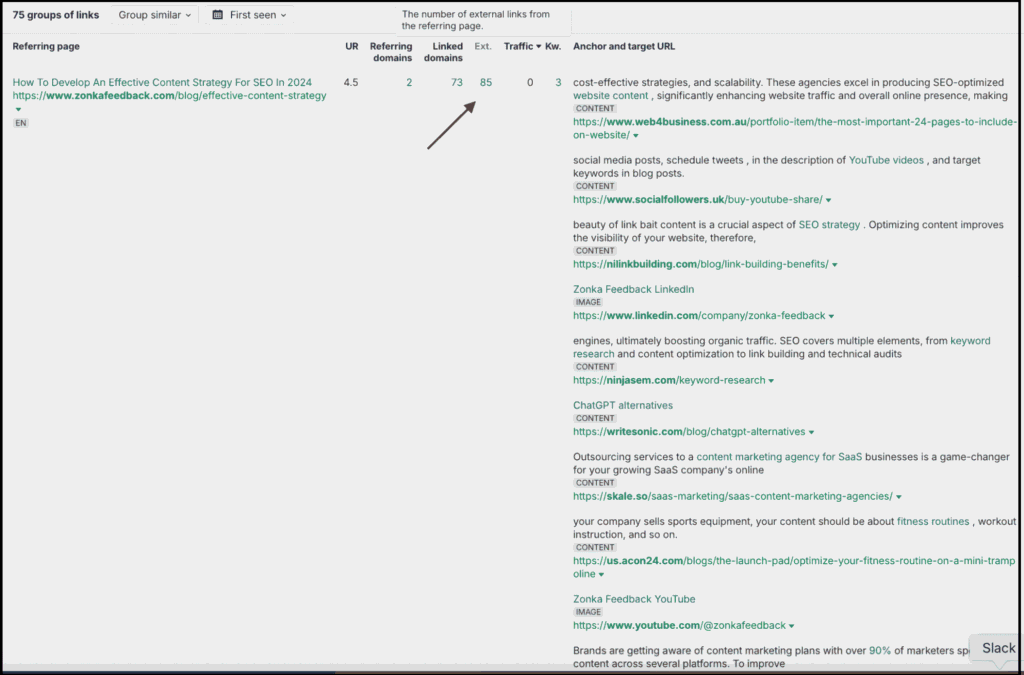
While they may appear editorial, the sheer volume reduces the individual impact of each link. When your link is surrounded by many similar outbound references, it signals less exclusivity and weaker endorsement.
Instead of placing links on pages crowded with similar references, prioritize pages that:
- Have limited but highly relevant outbound links
- Feature deeper topical focus
- Integrate your link naturally within the core discussion
6. Linking Root Domains
Linking root domains reveals how many unique websites are referencing your brand and, more importantly, which websites those are.
It’s not enough to track the number of referring domains. You need to evaluate the quality behind them.
When reviewing your linking root domains, ask:
- Are these domains relevant to your industry?
- Do they receive consistent organic traffic?
- Do they rank for meaningful keywords?
- Are they editorial sites, real businesses, or low-value directories?
A growing count of referring domains only adds value if those domains themselves carry authority and visibility.
For example, gaining 20 new links from niche-relevant industry publications with steady traffic is far more impactful than gaining 100 links from inactive blogs or low-quality directories.
You should also assess concentration. If a large percentage of your links come from the same publishing network or a cluster of similar sites, your authority becomes centralized rather than diversified. Search engines interpret broader endorsement across independent domains as a stronger trust signal.
This metric helps you evaluate whether your link building efforts are expanding your authority footprint or simply increasing link volume within the same ecosystem.
6. Cost Per Link
Cost per link is an important link building quality indicator.
Links acquired through quick submissions or low-effort placements may appear cost-effective, but they rarely build durable authority.
Bulk directory submissions, for instance, can generate hundreds of backlinks within hours. However, these links lack editorial context, require minimal scrutiny, and are easily replicated by competitors.
While the volume may look impressive, the long-term SEO value is limited and in some cases, risky.
The same applies to offers advertising “DR 50+ backlinks” for $10–$50. These placements often come from irrelevant or low-quality websites.
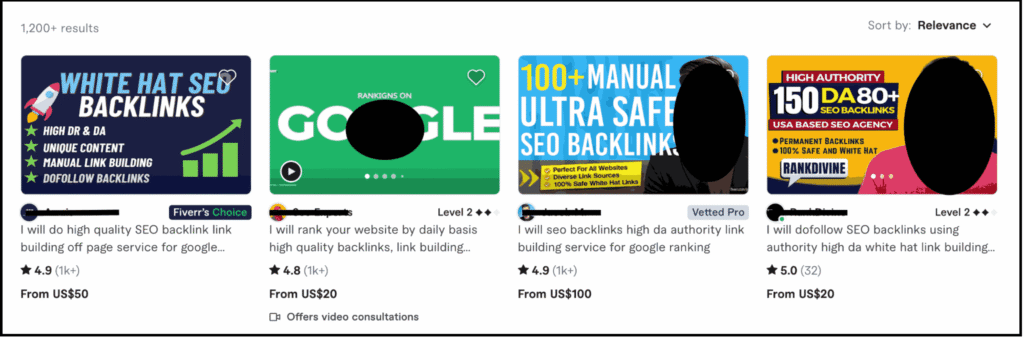
In contrast, an editorial link placed within a well-written industry article requires genuine outreach, content alignment, and approval from the publisher. It takes time to secure and cannot be obtained in a few clicks.
Because it is contextual and selectively placed, it carries significantly more weight.
Trusted, white-hat agencies focus on securing these high-quality placements through strategic outreach rather than automation.
Smart Link Building Checklist for 2026
Before scaling any campaign, run through this quick audit:
Are the domains relevant to your industry?
Does the linking page receive organic traffic?
Is your referring domains-to-backlinks ratio healthy?
Is link growth steady rather than spiky?
Are links placed contextually within editorial content?
Are anchors diversified and natural?
Are links indexed and crawlable?
Are you building links to revenue-driving pages?
If several boxes remain unchecked, focus on fixing the structure before adding volume. Authority compounds best when built intentionally.
Turning Link Building Into Measurable Growth With Tanot Solutions
Link building in 2026 requires discipline. It means filtering placements through relevance, sustainability, and business impact.
At the same time, it means resisting vanity metrics and focusing on strategic growth.
At Tanot Solutions, we don’t deliver link dumps. Every backlink we build is vetted for quality and approved by you before publishing. We ensure to align with your DR and traffic requirements and map them to your growth objectives.
That’s why we provide structured reporting that goes beyond link counts and includes clear updates on backlinks acquired, referring domain growth, authority improvements, and much more.
With 5,000+ backlinks delivered and an 85%+ retention rate, our philosophy remains simple:
“We don’t just build links. We build leverage.”
If you’re ready to turn link building into a measurable growth engine, connect with us today.