

SEO for news websites is no longer just about being first.
In 2026, news publishers are dealing with volatile Google Discover traffic and increasing competition from AI-generated summaries and aggregators.
23% of people in the U.S. get their news from AI bots, up from just 8% in 2024. That’s not a marginal shift but a behavioral one in how audiences consume news. If you want to better understand how AI-driven search systems surface and summarize content, you can explore our in-depth guide on ChatGPT SEO.
Search engines are raising the bar, rewarding authority and credibility just as much as freshness.
This is why SEO for news websites has become harder than ever, and why many established news portals are struggling to sustain organic traffic despite publishing at scale.
Why SEO for News Websites Is Struggling to Get Traffic
On the surface, many news websites appear to be doing everything right:
- Publishing dozens (or hundreds) of articles daily
- Optimizing headlines for clicks
- Aggressively chasing trending keywords
Yet organic traffic remains inconsistent.
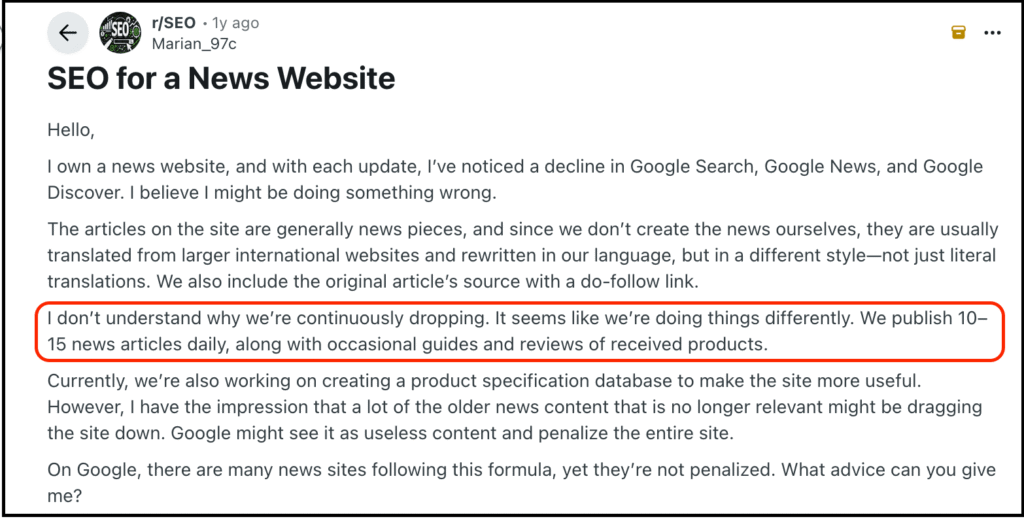
This frustration is common across publisher communities. Even sites publishing 10–15 articles a day report declining visibility, a clear sign that volume alone is no longer enough to win in search.
To understand why this happens, let’s look at how Google evaluates news content today and how news SEO differs from traditional SEO models.

How SEO for News Websites Works Differently Than Traditional SEO
News websites don’t compete on the same playing field as SaaS, B2B, or eCommerce sites. They operate at scale, under time pressure, and with constant editorial turnover.
This creates a unique SEO environment where speed matters, but sustainability matters more.
Several structural factors define SEO for news websites, starting with the most persistent challenge.
- The freshness vs. authority dilemma
Freshness helps you get indexed, and authority helps you stay visible.
Most news sites optimize heavily for:
- Speed
- Publishing velocity
- Trending topics
This approach works in the short term. But without authority, rankings drop as soon as competitors publish similar stories or when the news cycle moves on.
Winning publishers solve this by balancing breaking news with authoritative evergreen content and editorial references from other credible sites. Over time, these signals help search engines view the publication not just as fast, but as reliable.
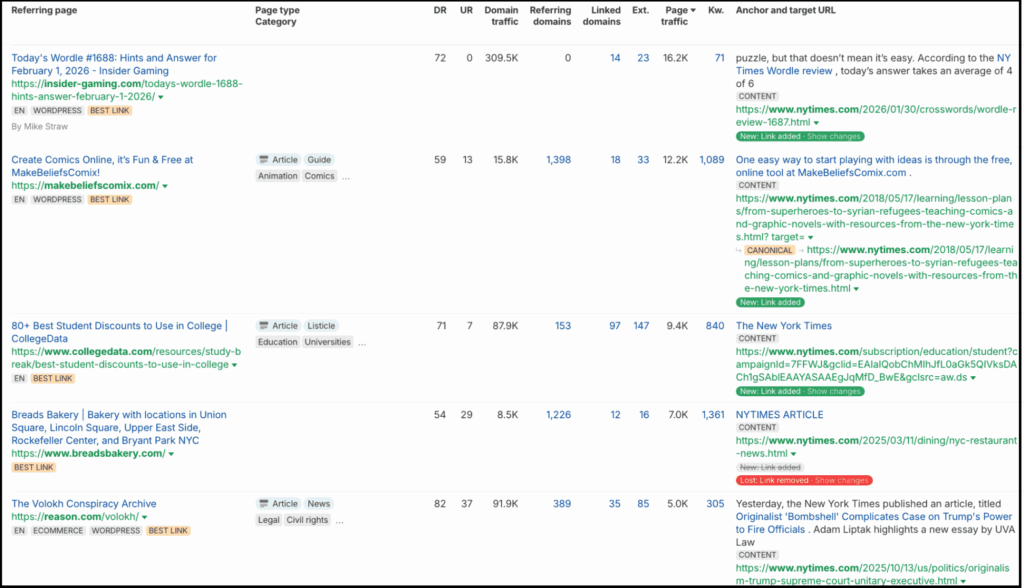
The New York Times has over 200 million backlinks pointing to its site. That level of authority isn’t accidental. It’s the cumulative result of relevance and long-term credibility.
- Crawl budget challenges at scale
Large news portals can publish thousands of URLs every month. But Googlebot doesn’t have unlimited capacity.
Crawl budget refers to the finite amount of attention a search engine allocates to crawling your site. When it’s wasted on low-value URLs, important pages may not get crawled, indexed, or refreshed quickly enough.
Common crawl budget issues include:
- Thin tag and category pages
- Infinite archives and pagination
- Duplicate or low-priority URLs
Without crawl optimization, even high-quality journalism can struggle to maintain consistent visibility in search.
- Monetization pressure vs. traffic quality
The end goal of any news website is revenue. Ads, paywalls, popups, and rich media are often necessary, but they come at a cost.
Over-monetized pages frequently suffer from:
- Poor core web vitals
- Higher bounce rates
- Reduced eligibility for Google Discover
Google has clear guidelines on better ad standards, which benefits both users and advertisers.
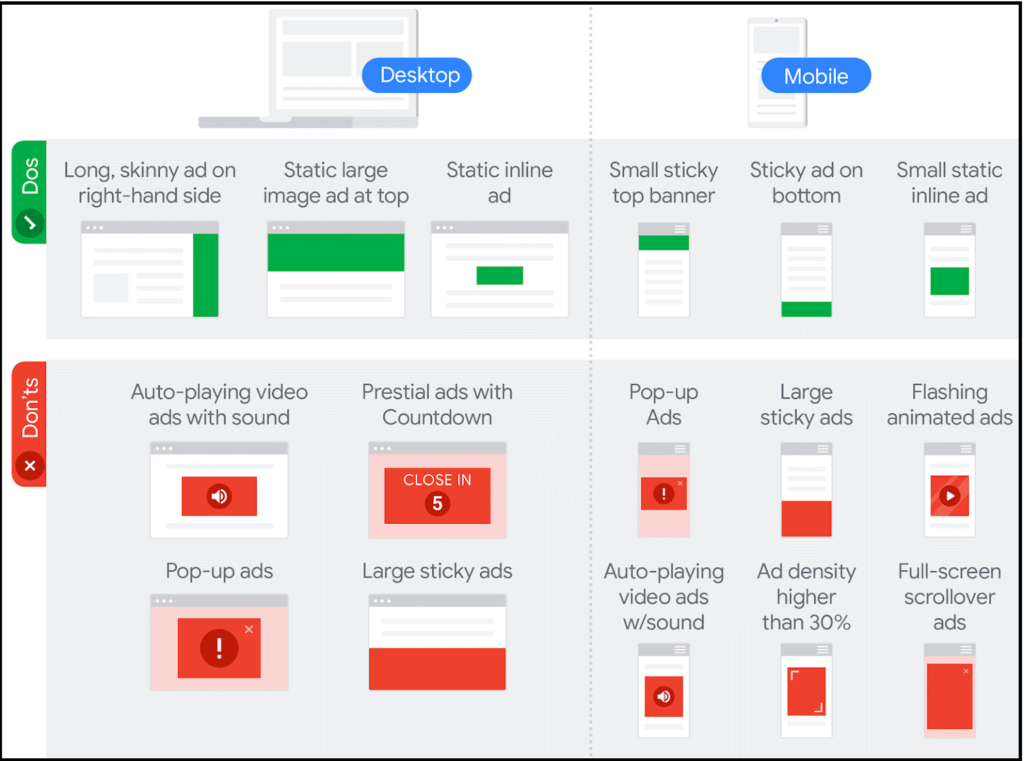
Do’s and don’ts of display-ad standards to maintain a good user experience.
In 2026, SEO success for news websites depends less on raw traffic volume and more on traffic quality and user experience. Search engines increasingly reward pages that users actually engage with.
How to Optimize SEO for News Websites in 2026
News SEO today requires a structured, system-level approach.
To build sustainable visibility, publishers need to optimize across four core pillars:
1. Content optimization for news portals
For news organizations, SEO is not the product; content is. SEO’s role is to make that content discoverable, competitive, and durable.
Unlike traditional marketing sites, news portals don’t need SEO to generate ideas. They need SEO to amplify what already matters: the stories, angles, and expertise the newsroom is producing every day.
- Evergreen explainers vs. breaking news
You need the right content mix of breaking news and evergreen content for increased visibility.
For breaking news, the SEO focus should be tactical and fast:
- Ensuring headlines (and all headline variations) target the most relevant real-time queries
- Strengthening internal links from high-traffic stories to context pages
- Identifying follow-up angles based on trending searches and competitor coverage
Your goal here should be speed and discoverability. CNN, for instance, has already updated its coverage of the 2026 Grammy Awards to align with emerging search interest.

Evergreen content, on the other hand, is where long-term SEO is built. News websites should clearly define:
- Which sections or pages are considered evergreen priorities
- What “high-quality evergreen content” means internally
- How evergreen standards differ from daily news reporting
Long introductions, shallow coverage, and minimal formatting, which are common in daily news workflows, often limit evergreen pages from competing effectively in search.
The most successful news publishers treat evergreen content as a separate editorial asset, with its own standards, review process, and SEO expectations.
To put simply, breaking news brings attention while evergreen content earns authority. Here’s an example of how an evergreen topic looks on a news website.

2. Backlink strategy for news websites
This is the most underdeveloped pillar for news websites, and often the most misunderstood. Many publishers assume: “If our journalism is good, links will come naturally.”
In reality, that’s only partially true.
Why link building matters for news websites
Search engines use backlinks as external validation:
- They confirm credibility
- They differentiate trusted publishers from lookalikes
- They help evergreen content outperform short-lived coverage
With AI-powered summaries, answer cards, and generative SERPs becoming more prominent, authority signals increasingly determine which sources are referenced, cited, or surfaced.
Without strong authority signals, even well-written articles struggle to hold rankings once competition intensifies and risk being excluded from AI summaries altogether.
For example, an evergreen podcast content from The New York Times attracts over 684k organic visits, supported by links from 196 unique referring domains.

This is a clear demonstration of how authority compounds visibility over time.
- Editorial links vs. syndicated links
Not all links contribute equally to authority.
Syndicated links are links that come from content republished across multiple sites, such as wire stories, press feeds, or content-sharing networks. While syndication helps with reach and distribution, these links are often duplicated across many domains, lightly contextualized, or devalued by search engines due to repetition.
As a result, syndicated links tend to have limited impact on long-term SEO authority, especially for competitive or evergreen queries.
Editorial links, on the other hand, are earned when another publication independently references your reporting, analysis, or explainers within their own original content. These links carry significantly more weight because they signal genuine editorial trust.
The strongest authority signals typically come from:
- Contextual mentions within relevant, original articles
- Links placed naturally within editorial content
- Publishers with real readership and engagement, not just high domain ratings
For news websites, the goal isn’t widespread duplication. It’s credible, editorial validation that search engines and AI-driven SERPs recognize as trust.
This is where many publishers partner with agencies like Tanot Solutions to build high-authority, publisher-relevant backlinks. We offer full transparency and follow the approval-first process before links go live.
3. Crawl optimization for news publishers
Crawl optimization is about helping search engines discover newly published articles quickly. When Google can find a story fast, it can index it sooner, which directly affects visibility in search results, Top Stories carousels, and other news-specific features.
When you’re publishing at scale, it introduces a hidden SEO risk: crawl waste.
Googlebot doesn’t crawl everything equally. When too many low-value URLs exist, important stories may not get crawled or refreshed quickly enough.
Common crawl budget killers for news sites
- Thin tag and category pages
- Infinite pagination and archives
- Duplicate URLs created by filters or parameters
Over time, this dilutes search engine attention.
How news websites should optimize crawl budget
Effective crawl optimization includes:
- Noindexing low-value or duplicate pages
- Cleaning up unused tags and archive URLs
- Strengthening internal linking toward priority content
- Ensuring evergreen pages remain crawl-accessible
You can figure out where your crawl budget is currently being spent. The Crawl Stats report in Google Search Console shows how quickly Googlebot crawls your URLs.
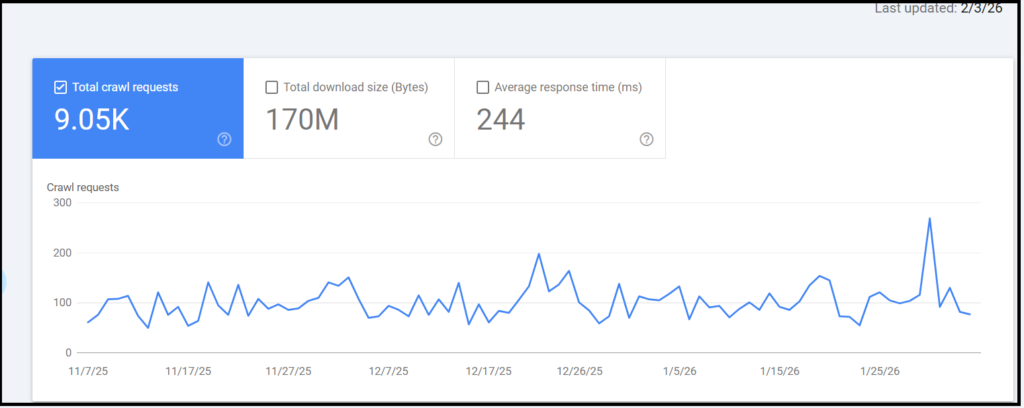
Understanding how Google crawls and prioritizes websites is critical to making these decisions, especially for news publishers operating at scale.
4. Technical SEO for supporting newsroom performance
Technical SEO is the foundation that allows everything else to work. When technical signals aren’t clear, even strong reporting can miss time-sensitive visibility, including eligibility for Google’s Top Stories and Discover features.
Here are the core technical priorities for news websites:
- News XML sitemaps
Well-maintained news sitemaps help Google identify what’s new and important:
- Separate sitemaps for recent articles
- Accurate publication and update timestamps
- Automatic removal of expired URLs
These signals play a critical role in how quickly stories are discovered and evaluated for news-specific SERP features.
- Core web vitals
Performance directly impacts visibility:
- Optimize largest contentful paint (LCP) for image- and video-heavy pages
- Reduce layout shifts caused by ads
- Prioritize mobile performance for Discover traffic
Pages that load poorly or shift excessively are less likely to be surfaced in high-visibility placements.
- JavaScript & rendering
Search engines need immediate access to core content:
- Use server-side rendering for headlines and body text
- Minimize render-blocking scripts
- Ensure Googlebot can access article content without user interaction
In fast-moving SERPs, technical clarity helps Google make ranking decisions in seconds.
Pro-tip: For news publishers, visibility in Google’s Top Stories block is one of the highest-impact traffic opportunities available.
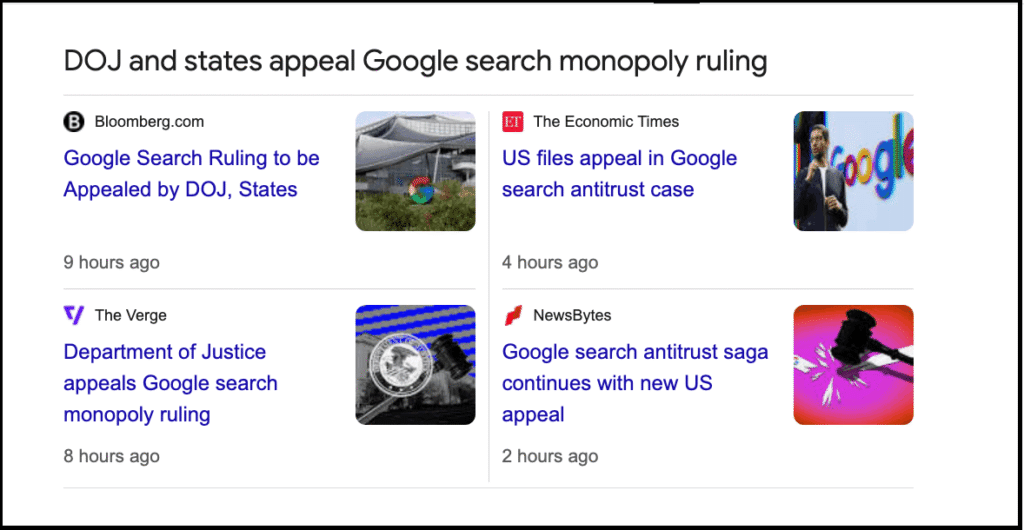
Google’s SERPs Top Stories section
Top Stories rankings are decided in seconds, often before traditional ranking signals fully settle. In these moments, Google relies primarily on technical and structural cues, not deep content analysis.
This makes two things especially important:
- Clear prominence signals, such as featuring key stories on the homepage and relevant section pages
- Accurate structured data, including NewsArticle and LiveBlogPosting, to help Google understand the nature and timeliness of the content
Large publishers like The New York Times reflect this clearly in their homepage structure, separating live reporting from opinion and evergreen sections to reinforce editorial intent and freshness signals.
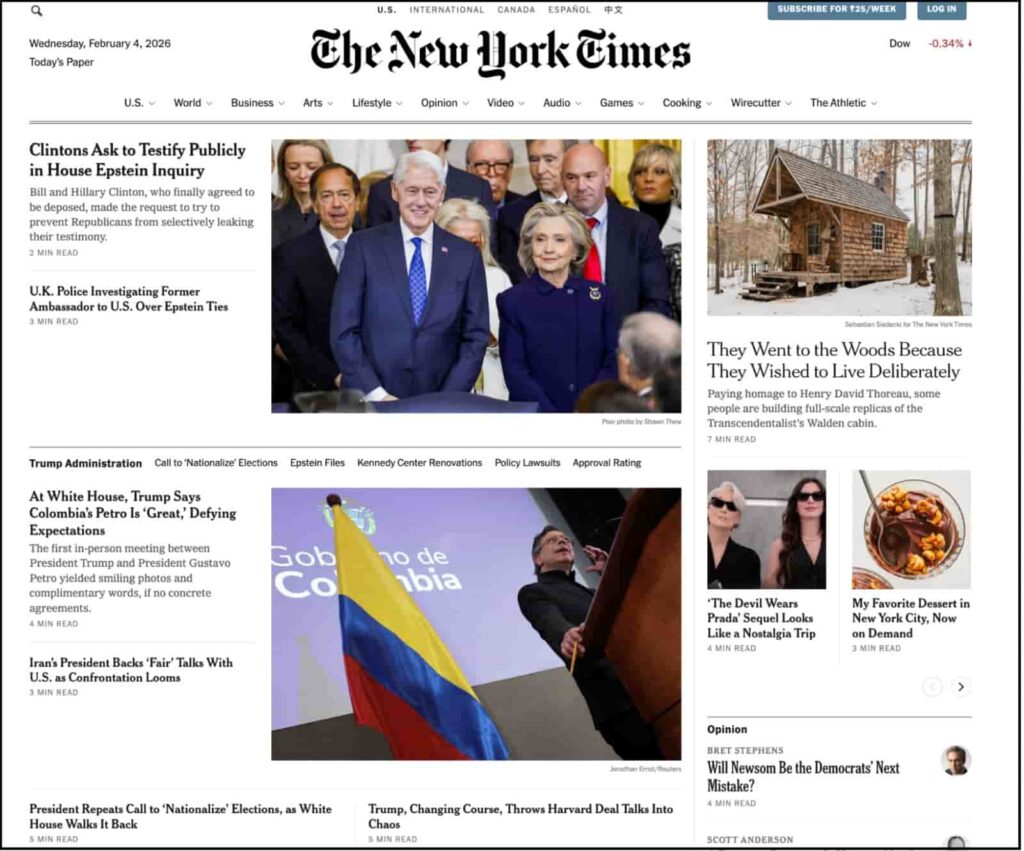
Local News SEO Tips for Regional Publishers
Local news websites have a built-in SEO advantage: geographic relevance.
Search engines strongly favor sources that demonstrate consistent coverage and authority within a specific location.
Effective local news SEO focuses on:
- Location-based authority pages (e.g., city, county, or neighborhood hubs)
- Coverage hubs that consolidate ongoing stories for a region
- Local backlinks from institutions, schools, nonprofits, government bodies, and community organizations
For example, a regional publisher like Fox 11 Los Angeles maintains a dedicated Local News hub that is consistently updated with coverage on elections, public policy, and community events.
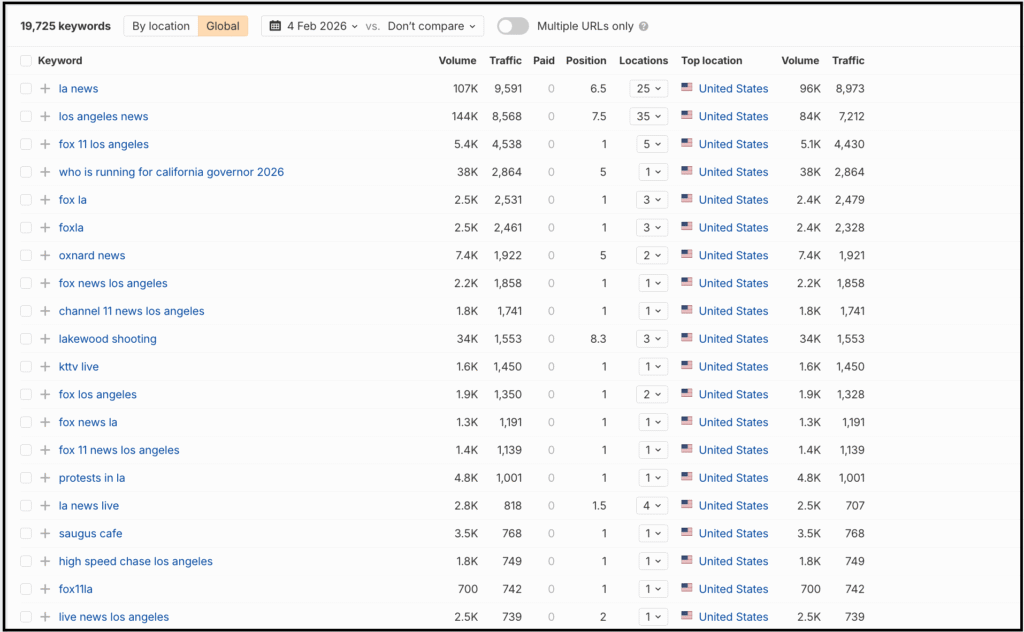
This signals strong geographic relevance to search engines and helps the site earn sustained rankings for geographically qualified queries.
Because these signals are rooted in real community presence, they’re difficult for national outlets to imitate. This makes local SEO one of the most defensible growth channels for regional news publishers.
Conclusion: The Future of News SEO Is Authority-First
For news websites to win in search, it needs to be not only the fastest but also the most trusted.
That means SEO for news websites has shifted from a race for freshness to a long-term authority strategy. Publishers that invest in credibility, technical rigor, and high-quality editorial backlinks build visibility that compounds over time, instead of resetting with every news cycle.
If your news website is facing traffic volatility, declining search visibility, or authority gaps, Tanot Solutions helps publishers build scalable, white-hat backlink strategies.
Our link building service is designed to strengthen rankings, credibility, and ROI without compromising editorial integrity. Contact us to know more.
Frequently Asked Questions (FAQs)
How can news websites keep getting organic traffic after a story stops trending?
Most news articles lose traffic after the news cycle ends. To keep organic traffic, publishers should turn important stories into evergreen guides or explainers. Updating the article with context, statistics, and internal links can help it rank for long-tail keywords and continue bringing search traffic over time.
How fast should news articles be indexed in Google for better rankings?
Speed matters a lot in news SEO. Ideally, news articles should be indexed within minutes or a few hours after publishing. Using a news sitemap, proper internal linking, and fast page loading helps search engines crawl new stories quickly and improves the chances of appearing in Top Stories results.
How can news publishers build authority in competitive search results?
News publishers can build authority by earning editorial backlinks from trusted websites, covering topics consistently, and publishing reliable reporting. Search engines favor sources that show expertise and credibility. Over time, strong backlinks and topical authority help news websites rank higher and maintain stable organic traffic.
What type of content helps news websites rank for long-term search traffic?
Besides breaking news, publishers should create evergreen content such as explainers, background stories, and industry analysis. These pages target informational search queries that remain relevant for months or years. Combining evergreen content with strong SEO optimization helps news websites build steady organic traffic.
Why do some news websites lose rankings even when they publish daily?
Publishing frequently does not guarantee better rankings. If articles lack authority, backlinks, or proper SEO structure, search engines may prioritize more trusted sources. Improving internal linking, strengthening technical SEO, and earning high-quality backlinks can help publishers maintain search visibility despite strong competition.
How can internal linking improve SEO for large news websites?
Internal linking helps search engines understand the relationship between news stories and important topics. Linking related articles, topic pages, and evergreen content improves crawl efficiency and distributes authority across the website. This also helps readers find more relevant stories and increases engagement and time on site.
What metrics should news publishers track to measure SEO success?
News publishers should monitor organic traffic, keyword rankings, indexing speed, and referral backlinks. Tracking Google Discover traffic, engagement metrics, and returning visitors can also show how well content performs. These insights help publishers refine their SEO strategy and focus on topics that consistently drive search visibility.