

In 2026, the old idea that “more backlinks equal better rankings” no longer holds.
Search engines have become far more sophisticated in how they evaluate links. Instead of simply counting backlinks, modern algorithms analyze topical relevance, contextual placement, and the authority of the linking website.
This is why niche relevant backlinks have become one of the most valuable assets in SEO today.
A single contextual link from a trusted industry publication can often carry more ranking power than dozens of generic links from unrelated websites.
Yet many companies still fall into the same trap: overpaying for backlinks that look impressive in reports but offer little real SEO impact. High Domain Rating (DR) scores, inflated traffic metrics, and mass guest-post placements can easily hide the fact that a website has little connection to your industry.
The result? Budgets get spent, reports show new links, but rankings barely move.
To avoid this, SEO teams need a clear framework for identifying, evaluating, and securing niche relevant backlinks that actually strengthen topical authority.
This article will walk through the exact process for finding and securing these backlinks without overpaying for vanity metrics.
And if you’d rather skip the prospecting and outreach process, Tanot Solutions offers a strategic link building service focused on acquiring contextual, high-authority backlinks from vetted industry publications.
What Are Niche Relevant Backlinks
Niche relevant backlinks are links from websites that operate within the same industry or topical ecosystem as your business.
Instead of coming from random blogs or generic publishing networks, these links appear on sites that already discuss topics related to your products, services, or audience.
For example:
| Your Industry | Example Niche Backlink Source |
| SaaS marketing tool | Marketing strategy blogs |
| Fintech platform | Finance or investment publications |
| E-commerce platform | Retail and e-commerce industry blogs |
Because these sites already publish related content, the backlink appears natural and contextually relevant.
Search engines analyze the surrounding content, entities, and keywords around a link. When a backlink is embedded within relevant editorial content, it signals that your site is a trusted resource within that topic.
This is one reason why contextual backlinks consistently outperform generic placements.
For businesses investing heavily in SEO, niche backlinks help build topical authority. This is a factor that has become increasingly important with Google’s Helpful Content and Spam Updates.

How to Find Niche Relevant Backlinks
Finding niche backlinks isn’t about scraping massive link lists or purchasing bulk placements.
Instead, the process involves identifying websites already publishing content in your industry and then building relationships with those publishers.
Here’s a structured approach.
1. Decide your target links and anchor text
Before searching for websites, you need clarity on what type of links you actually need.
Start by identifying:
- Pages you want to rank
- Target keywords for those pages
- Natural anchor text variations
Your anchor strategy should look natural and diversified. Besides, the list of anchor text could be a mix of:
- Branded anchors
- Partial keyword anchors
- Natural phrase anchors
- Generic anchors
This step prevents a common mistake: acquiring links without a clear ranking objective.
2. Find niche relevant websites
Once you know the type of links you want, the next step is identifying websites that publish relevant content. The goal is to find editorial websites with topical alignment and real organic traffic.
Here are three effective methods to do so.
i. Use Google search operators
Search operators are one of the easiest ways to discover niche websites. Instead of searching broadly, use combinations that reveal sites publishing industry-specific content.
For example, if you run an SEO agency, you might search:
inurl:blog “SEO strategy”
This will show blog pages specifically publishing content related to SEO strategy.
You can also use domain-based operators to discover authoritative organizations or educational resources in your niche:
site:.edu “SEO research”
site:.org “SEO best practices”
These queries often uncover industry associations, research institutions, or educational websites that publish credible content related to your topic.
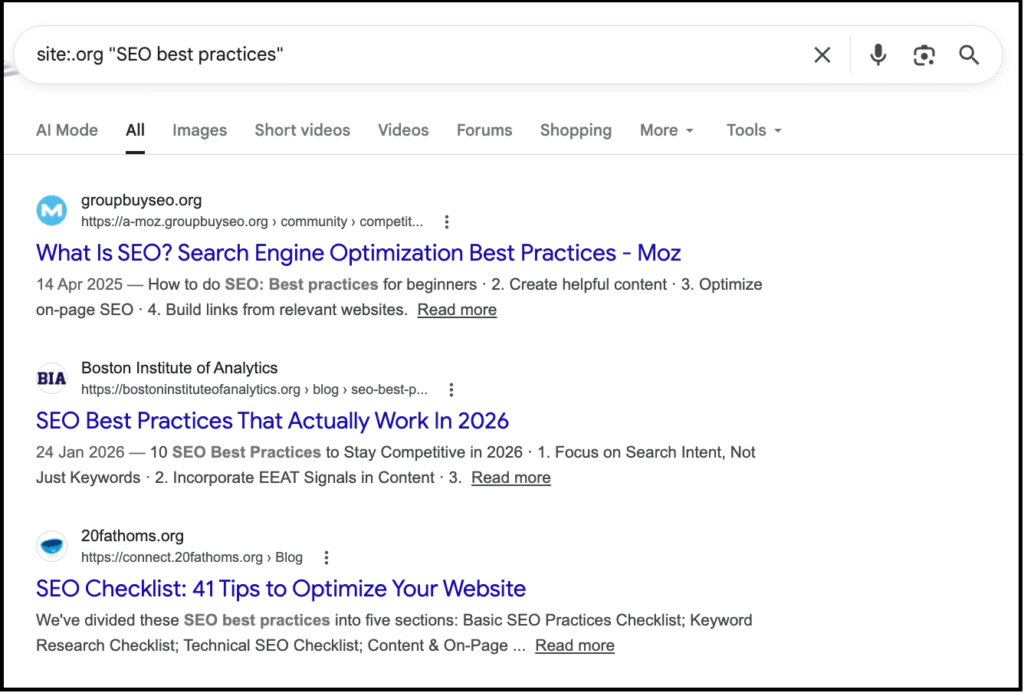
Screenshot of Google results using a search operator.
When evaluating websites, check for:
- Domain authority / DR
- Organic traffic trends
- Relevance of published topics
- Target country traffic (US/UK)
ii. Competitor backlink gap analysis (using Ahrefs Link Intersect)
Another powerful method is analyzing where your competitors already have backlinks. Tools like Ahrefs provide a feature called “Link Intersect.”
Here’s how it works:
1. Click on Link Intersect in the Ahrefs sidebar and enter the domains of three to four competitors.
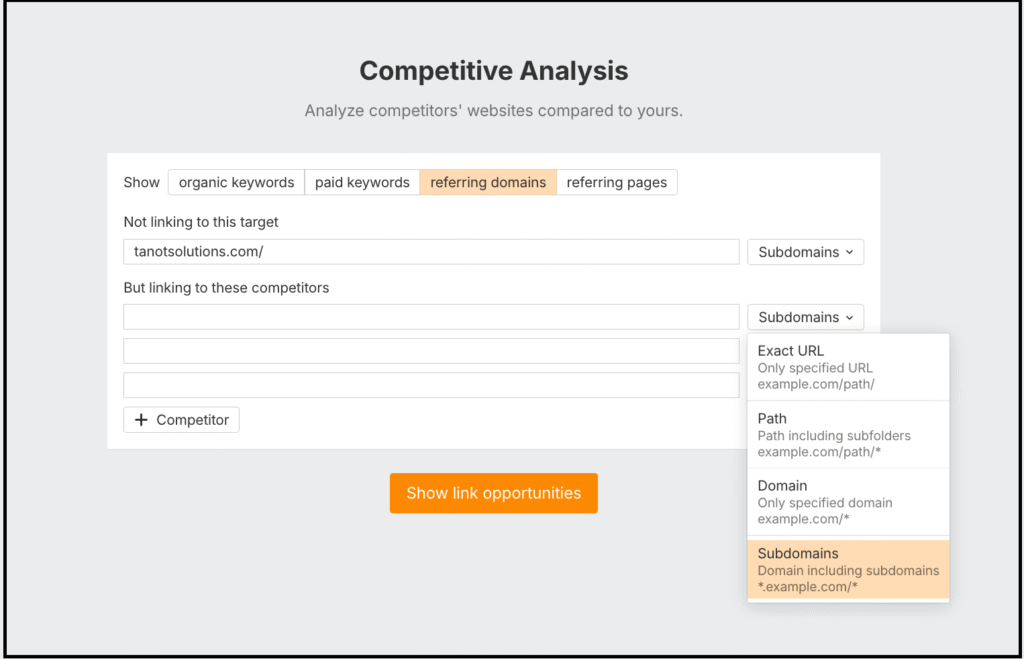
2. You can choose whether to analyze the entire domain, subdomains, or a specific URL, depending on how narrow you want your search to be.
3. Once you’ve entered the details, click Show link opportunities.
4. Ahrefs will generate a list of domains that are linking to your competitors but not to your site. From here, you can apply filters based on metrics like domain rating, traffic, or number of linking competitors to identify the most relevant backlink opportunities.
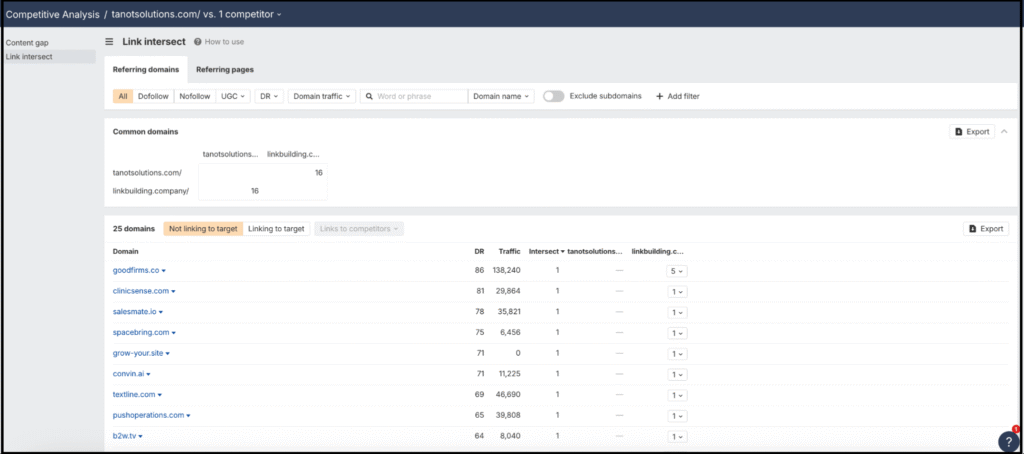
These websites are often highly relevant to your industry. Because they’ve already linked to similar businesses, they’re more likely to link to you.
This approach removes guesswork and helps you find validated niche authority sites.
iii. Topic-based content reverse engineering
Another effective technique is studying top-ranking content in your niche. Search your primary commercial keywords and analyze the pages ranking on page one.
Then:
- Extract their backlink profiles
- Identify recurring referring domains
- Look for patterns in linking sites
You may notice that certain blogs or publications frequently link to content in your industry. These websites form your link ecosystem.
Instead of cold outreach to random sites, focus on publications already participating in that ecosystem.
3. Reach out using a personalized pitch
Once you’ve identified relevant websites, the next step is outreach. The key here is personalization.
Studies have shown that personalized emails can deliver up to 6x higher transaction rates and significantly higher open rates compared to generic outreach.
Editors receive hundreds of generic guest-post requests every week. If your outreach email looks like it was sent to dozens of websites at once, it will likely be ignored.
A strong pitch should:
- Reference a specific article from their website
- Suggest a topic that aligns with their audience
- Demonstrate your expertise or unique insight
Here’s a simple outreach template you can use:
| Subject: Quick suggestion for your article on [Topic] Hi [Editor’s Name],I was reading your article on [Article Title] and found it really helpful, especially the section on [specific point]. I noticed you mentioned [topic related to your content], and I thought this guide might add value for your readers: [Your resource link] It covers [brief description of what the content includes] and could work well as an additional reference in the section discussing [relevant part of their article]. If you think it would help your readers, feel free to include it. Thanks for the great content! Best, [Your Name] |
If you want more examples and proven frameworks, you can explore our link building email outreach templates here.
4. Establish relationships with editors
Successful link building often comes down to relationships. Instead of approaching publishers as one-time transactions, focus on long-term collaboration.
Ways to build relationships include:
- Offering expert insights for future articles
- Featuring them in your newsletter
- Sharing their content with your audience
- Partnering on content collaborations
- Exploring relevant link exchanges
Editors prefer working with contributors who add value consistently, not those who only want backlinks.
Over time, these relationships make acquiring backlinks significantly easier.
5. Submit your link placement request
Once your content is approved or collaboration is established, you can submit your backlink request.
This typically happens through:
- Guest articles
- Contextual link insertions
- Resource mentions
- Industry roundups
- Expert contributions
At this stage, ensure the link placement is:
- Natural within the content
- Surrounded by relevant keywords
- Helpful to readers
Forced links can appear manipulative and weaken SEO impact.
Best Practices for Securing Niche Relevant Backlinks Without Overpaying
Finding niche-relevant websites is only half the job. The real challenge is securing backlinks from them without wasting budget on low-value placements.
The following best practices will help you focus on relevance, quality, and long-term SEO impact.
i. Write a proper, context-driven pitch
Most outreach emails fail because they focus on what the sender wants instead of what the editor needs.
Your pitch should clearly explain:
- Which specific article you’re referring to
- Where your resource could fit naturally within that content
- How your page adds useful information for its readers
For example, if an article discusses SEO strategies and you have a guide expanding on niche relevant backlinks, suggesting it as an additional resource can strengthen the content.
The key is to position your link as a helpful addition to their article, not just a backlink request.
Editors respond to relevance and usefulness, not generic outreach templates.
ii. Create high-quality, link-worthy content
The quality of your content plays a major role in how easily you secure backlinks.
Strong link-worthy content typically includes:
- Original insights or data
- Industry examples
- Clear formatting and structure
- Practical advice readers can apply
When content genuinely adds value, editors are far more comfortable linking to it as an additional resource for their readers.
iii. Prioritize relevance over domain rating
A common mistake in link building is prioritizing domain rating alone. While DR is useful, relevance matters far more.
A contextual backlink from a niche industry site with moderate authority often provides more SEO value than a high DR link from an unrelated blog.
When evaluating backlink opportunities, focus on:
- Topical alignment with your industry
- Audience relevance to your target market
- Editorial quality of the website and its content
These factors help strengthen your topical authority, which search engines increasingly rely on when determining rankings.
iv. Vet traffic quality (not just volume)
Traffic metrics can sometimes be misleading.
Before pursuing a backlink opportunity, look for signals such as:
- Traffic consistency over time
- Primary traffic sources (organic vs referral or direct)
- Country distribution of visitors
- Keyword rankings driving the traffic
A site with stable organic traffic is usually a better backlink opportunity than one with sudden spikes caused by viral content or expired domains.
Build Niche Relevant Backlinks With Tanot Solutions
Niche relevant backlinks are one of the most effective ways to build authority and improve search rankings. But acquiring them requires time, research, outreach, and relationship building.
Without the right evaluation framework, businesses often end up paying for links that offer little real impact. That’s why many SEO teams choose to work with specialized partners.
Tanot Solutions focuses on building contextual backlinks from industry-relevant publications that align with your niche, DR requirements, and traffic goals.
Every backlink is:
- Carefully vetted for relevance
- Placed within real editorial content
- Approved by clients before going live
This approach ensures companies invest in backlinks that actually strengthen topical authority and drive sustainable SEO growth.
If you want niche relevant backlinks that support rankings without wasting budget, contact us today.
Frequently Asked Questions (FAQs)
How can I tell if a backlink is truly relevant to my niche?
Check if the website covers topics closely related to your industry, audience, or products. Review the surrounding content and anchor placement to ensure it naturally aligns. Tools like Ahrefs or SEMrush can reveal topical relevance, and analyzing traffic sources helps confirm the link drives the right audience to your site.
Is it better to get one highly relevant backlink or multiple generic ones?
A single high-quality, niche-relevant backlink often outweighs dozens of unrelated links. It signals authority and contextual trust to search engines. Focus on backlinks that connect with your audience and appear in editorial content, rather than chasing quantity, to maximize long-term SEO benefits.
How can I approach websites for backlink opportunities without being ignored?
Personalization is key. Reference a specific article or resource on their site, explain how your content adds value to their readers, and propose a natural placement. Avoid generic outreach; concise, relevant emails increase your chance of securing high-quality backlinks and building lasting relationships with editors.
What types of content tend to earn niche backlinks more easily?
Content with original insights, data, case studies, or practical guides tends to attract backlinks naturally. Lists, industry reports, and actionable tutorials resonate with editors and readers. The more unique and useful your content is, the higher the chance it will be referenced by relevant websites in your niche.
How do I avoid overpaying for backlinks?
Focus on outreach to genuine, authoritative websites and create link-worthy content. Avoid paying for mass guest posts or links from unrelated sites. Prioritize editorial placements in niche-relevant publications, and track metrics like traffic and engagement rather than just domain rating, so your budget supports links that deliver real SEO impact.
How can I maintain relationships with editors for long-term link building?
Engage with editors by sharing their content, offering insights, and collaborating on future articles. Regular communication and consistent value builds trust, making it easier to secure future backlinks. Treat relationships as partnerships rather than one-time transactions for sustainable link acquisition.
How can I measure if my niche backlinks are improving SEO performance?
Track metrics like keyword rankings, referral traffic, and organic search growth from linked pages. Monitor how these links influence your backlink profile, domain authority, and topical authority. Over time, high-quality niche backlinks should result in measurable improvements in rankings and relevant organic traffic.